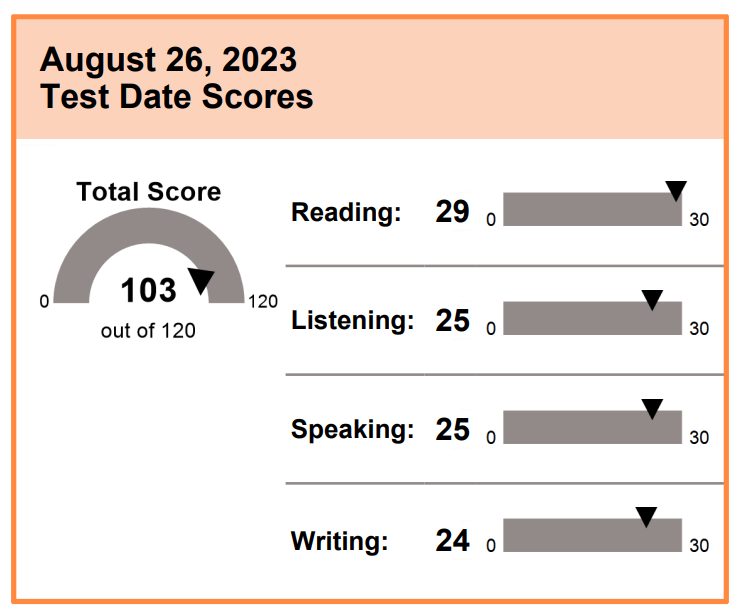
Score report:
Basic Information (For Reference)
- English level before the exam: I took CET-6 about two months earlier and scored 618.
- Preparation time: 16 days of classes + 20 days of self-study at home. Roughly only the final week was serious preparation.
- Cost: 16k RMB for classes + 2100 RMB exam fee.
- Practice volume (only counting self-study at home):
- Reading: about 10 sets
- Listening: 25 to 30 sets
- Speaking: 20 sets
- Writing: about 6 sets
This took almost my entire summer vacation. I had originally planned to preview some courses for the coming semester, but my efficiency at home was probably less than one third of my efficiency at school. So being able to complete TOEFL practice every day by relying on the guilt of wasting time was already not bad. Fortunately, the final result was quite satisfying. Although writing was a little doomed, the other three sections, especially the 25 in speaking, exceeded my expectations. So below I will share some personal preparation and exam experience for the TOEFL after the July 26 reform.
Should You Take a Class?
There are two benefits to taking a class: 1. Teachers teach test-taking strategies and help analyze your answers. 2. Practicing with classmates and teachers can effectively prevent slacking off.
For the first point, it is not strictly necessary. When I later prepared by myself, I also found many high-quality videos from creators on Bilibili and YouTube, and their methods were valuable too. In terms of granularity, offline teachers divide the question types more finely, so they cover more material. But after finishing those 16 days of classes, what I had learned and practiced was still far from enough to directly take the exam. On one hand, I was not yet familiar with time management. On the other hand, the actual ability to solve questions still required a large amount of practice before it could improve significantly. So I think that from the perspective of knowledge transfer, it is completely possible to practice at home by yourself, summarizing your own problems and methods while doing questions. The tradeoff is simply that you may need to do more practice.
For the second point, it depends on the person. If you have strong self-discipline and can keep practicing with quality and consistency for a month, then you do not need a class. Otherwise, you may be like me, fishing for three days and drying the net for two, with much lower efficiency. In that case, not taking a class may make things worse.
Summary: if you have strong self-discipline, watch Bilibili or YouTube teaching videos and summarize your own methods while practicing. Otherwise, take a class.
Exam Experience
- When the exam starts, you first enter the microphone test section. But at that moment, some students may still be entering the test room, so the actual start times can differ. This means that students who finish the microphone test early and begin reading may hear other students loudly testing their microphones during the first 5 to 10 minutes of reading. Be mentally prepared, and practice reading under interference. I was quite affected by this. The first reading passage happened to be difficult, and I could not absorb a single word in the first five minutes.
- Following the previous point, if an accident really wastes some time, do not panic. You may read faster during the real exam because of nervousness. When I practiced TPO at home, I usually used almost the full 36 minutes. But in the real exam, after wasting five minutes at the beginning, I sped up, finished both passages, and still had five minutes left. So I immediately went back to reread the first passage and corrected my initial answers. I eventually scored 29 in reading, which was already better than my usual average.
- Listening: when practicing TPO, I had never felt that listening time was insufficient. But during the real exam, the thinking time really felt as if it passed faster, meaning I was thinking more slowly. So still pay attention to time.
- Sometimes, for example when you reach writing, you do not necessarily have to skip the instructions. You can use that time to empty your mind, clear away previous thoughts, and think through the fixed expressions and phrases you may use in writing. This can save time during the actual writing section.
A Few Personal Tips
Because my speaking score was relatively high, I will mainly talk about how I practiced speaking.
- Speaking practice method: I deliberately “talked to myself” in English every day while showering and walking. That means continuously producing a speech in English. Imagine you are communicating with a foreigner. Do not make obvious pauses or retries; keep speaking in one flow. The content can be an independent speaking question you practiced that day, what you did today, or your opinion on something. This method trains your ability to express yourself in English, meaning you naturally express thoughts directly in English rather than translating from Chinese. As a result, your speaking becomes more fluent and natural. In addition, I think speaking still requires a lot of actual speaking, and the topics should be broad enough. We often get stuck because we think of a word but do not know how to say it in English. At that moment, if you have built a relevant corpus before, even if you cannot say the exact word, you can use an “explanation method” and describe it clearly in a sentence.
- About accent: although accent does not affect the score directly, such as with Indian accents, I think when Chinese speakers speak English, the issue may be more than accent. There can also be mispronunciation, no intonation, and no linking, making the speech less coherent. These should still affect the score. So I suggest checking word pronunciations more often and trying to ensure your pronunciation is correct. There are also many pronunciation teaching videos online.
- About the independent task (Speaking T1): I also think the 15-second preparation time is very tight. If you encounter a question that gives you no ideas at all, it is basically over. So the preparation method is to do a large number of questions. For the first attempt at each question, give yourself only 15 seconds to prepare, then immediately speak for 45 seconds. For the second attempt, you can spend more time thinking and try to say it better. This deliberately trains short-time brainstorming and also helps accumulate a corpus.
- About T2, T3, and T4: first, make sure you understand the reading and listening and catch as many details as possible. During preparation time, you can read your own notes aloud, recall the whole chain of events, and add some linking phrases. This can effectively prevent getting stuck or stumbling while speaking. Also, the key to these tasks is to make sure the entire structure is finished within the time limit, rather than covering every detail.
Finally, I hope everyone can get a satisfying TOEFL score and pass in one try.