In the blink of an eye, 2022 was over. This year was not exactly easy for me. Since I am writing a semester review, I will use it to look back on the second half of the year.
In early July, the transfer results came out, and unsurprisingly I failed to gain cross-major admission. No matter how many times I painfully replayed the afternoon of the programming exam, the result could not be changed. Because of my own insufficient ability, I lost in a competition for 20 spots to classmates who were more capable and harder-working. The goal I had worked toward for a year ended like this. From being trapped by the comprehensive-evaluation admission policy before enrollment and getting assigned to another major, to failing the second-track selection, and now failing the transfer, my college life has been rather bleak so far.
I had originally planned to stay on campus during the summer to make up the computer science courses I had fallen behind on. I did not expect it to become a summer spent making up the chemistry courses I had missed. I stayed at school, facing an empty dorm room and a future whose plan had been completely disrupted. During the summer I learned quite a few things: I signed up for mathematical modeling, teamed up with two classmates to prepare for the school contest and the national contest, and got rank 5 out of 70+ in the school contest (then did not even get a provincial third prize in the national contest); I self-studied Qt, crawlers, and Python data analysis, which also prepared me for later courses and arrangements; because the programming exam exposed that my typing was not smooth enough, I even practiced touch typing for a month. Learning these things did divert my attention so that I did not always think about the transfer. But no matter what, the hollow feeling of effort falling through kept lingering around me. I often wondered: compared with the failure to transfer, what was the point of learning these things?
I also signed up once as a volunteer to guide middle school students around Nanjing University during a summer camp. I still remember how, to make sure I could lead them smoothly through the chemistry building and the life sciences building the next day, I, someone who had barely been there before and could even get lost inside, walked the tour route through those two buildings again and again for an entire evening, until I knew without hesitation how to get to any location. One benefit of that volunteer work was that I became familiar with the chemistry building earlier and learned more about NJU Chemistry.
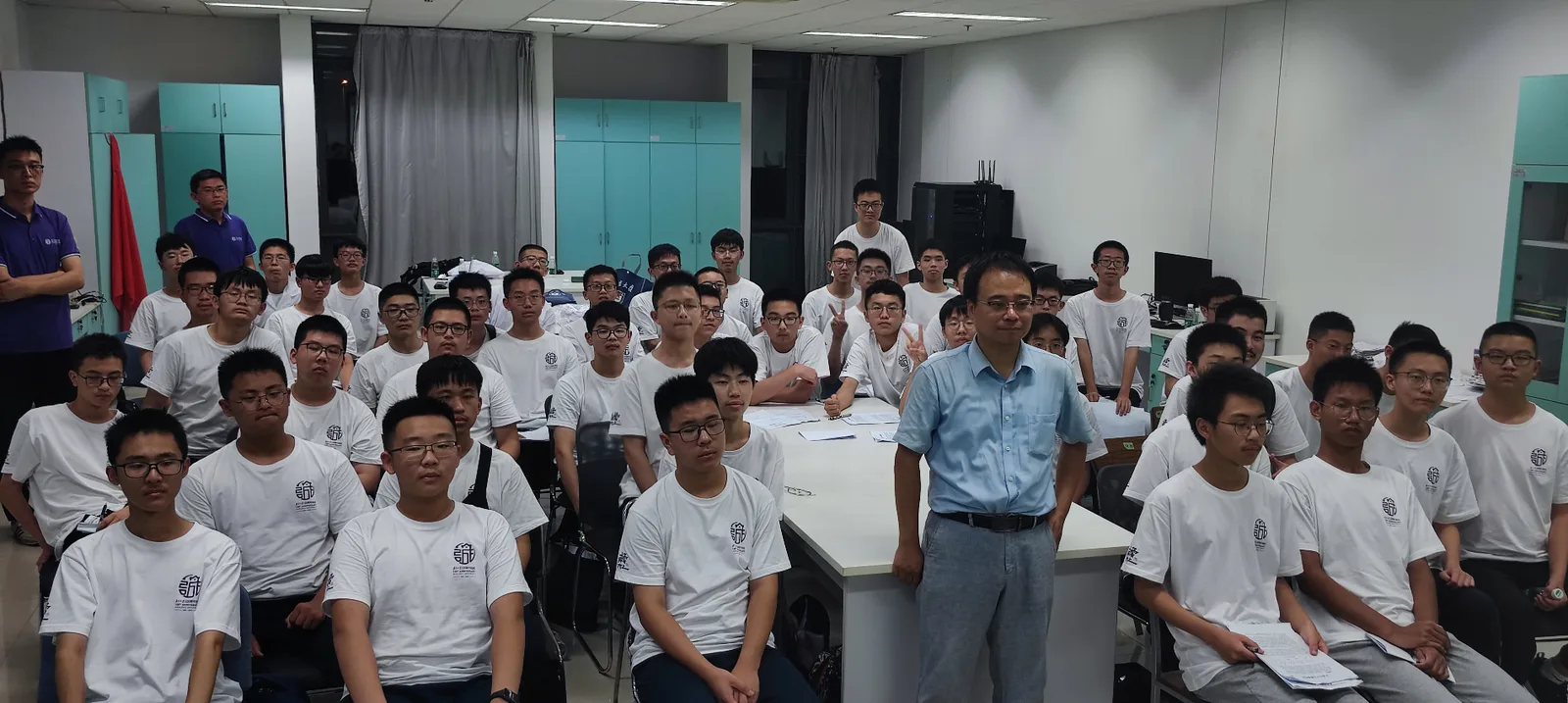
Soon, at the end of August, classmates returned one after another, and the new semester arrived. At first, seeing roommates and neighboring dormmates who had transferred smoothly did not feel good. But I knew I had to face this bleak reality. Since I had chosen to continue trying to transfer, the challenge was still there, hope was still there, and I had no time to sink into it.
After military training, a new administrative class was formed. Looking back at my entire freshman year, because I had focused on transferring majors, I did not run for class committee or grade committee positions, and I rarely took the initiative to join group activities. The result was that after a year, I still did not know many classmates in my grade. So I signed up for a small role and became the class psychological committee member, using it as a way to get to know my classmates better.
One or two weeks after the semester began, daily study officially got on track, and the pressure from courses gradually increased. Because I was transferring as a sophomore, I had seven major courses this semester. Since sophomore courses are basically all “hard courses,” more than 90% of my daily life was academic work. Whenever I had no class, I studied in classrooms or computer rooms to improve efficiency.
In chemistry, my problems were serious. Besides the three required chemistry courses I had previously missed, I had no prior knowledge at all for organic chemistry this semester. Sure enough, once the semester began, I could not understand organic chemistry lectures. In the first half of the semester, Professor Cheng Xu taught the course. His style was to go through the knowledge from beginning to end by himself, perhaps assuming that we already knew some things he considered basic, though in fact I did not. As a result, I often heard terms I had never encountered before, such as conjugation effect and rearrangement. Because I did not understand these at the beginning, larger concepts also sounded foggy. The homework was even harder. I basically did not know how to do it, so I had to spend a lot of time finding videos on Bilibili for self-study. In addition, because organic chemistry has a huge amount of content, and Professor Cheng even added several extra classes to finish it, our digestion efficiency was even lower. This organic chemistry course was one of the larger difficulties I encountered this semester. After spending a lot of time self-studying after class, mainly watching the BabyChem creator’s video series on Bilibili, I gradually went from understanding almost nothing to beginning to understand everything after about a month. In the second half of the semester, Professor Zhu Congqing’s teaching style was different. There was more interaction in class, questions before class, and review after class, so personally I felt that listening efficiency was much higher. Fortunately, organic chemistry rewards accumulation. Once the foundation became solid, the later parts were actually easier, so after overcoming the difficulty of the first half, things improved.
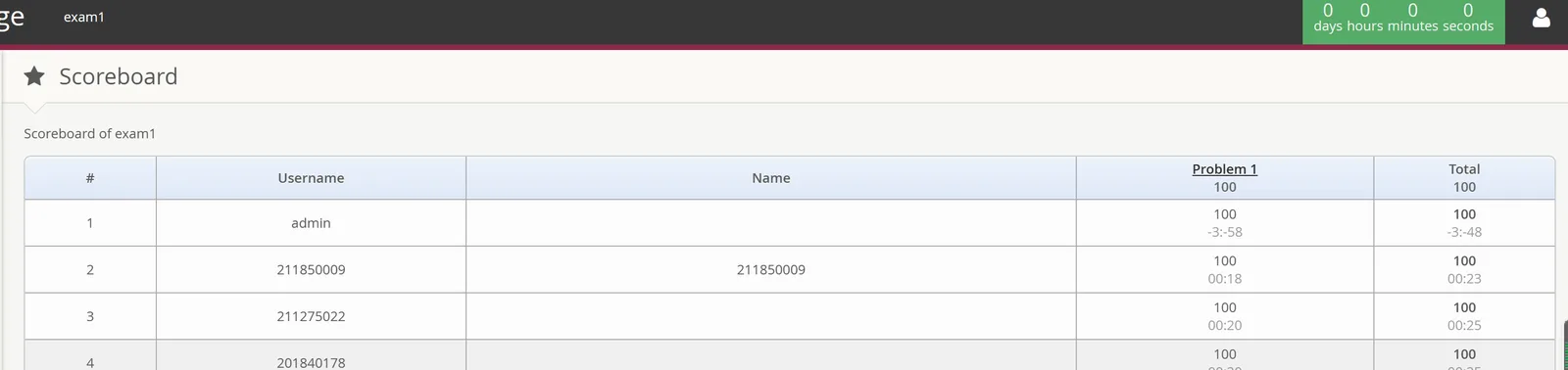
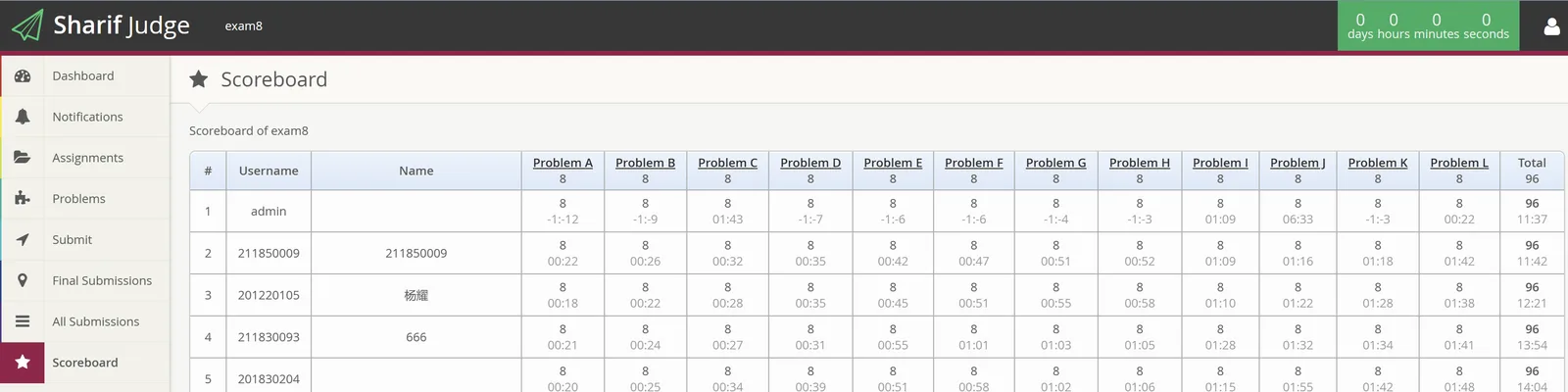
In computer science, the course pressure was significant, but it also trained me thoroughly. This semester I took Advanced Programming, a course I had been forced to drop midway through last semester because it was “too much of a blow.” Since I had self-studied QT during the summer and my coding ability had improved further, this time, even though I took the course with CS students from the class of 2020, my performance was pretty good: both projects received full marks, and I ranked first twice in OJ tests. That was some comfort for the efforts of an “outsider” like me. Another course worth mentioning was Data Structures. Because of a course conflict, I could only take it by exemption and had to spend extra time self-studying the missed classes. The biggest feature and challenge of this course was the weekly OJ homework and OJ contest, with real-time rankings, exactly like the transfer programming exam. This course also showed me the gap. Many students who had transferred successfully could rank in the top 20%, and they occupied the top positions year-round. Sometimes among the top ten, only one or two students were originally from the computer science department. I was often around rank twenty or thirty. This also showed that during the programming exam I was indeed less skilled, and there was still a gap between me and them. I still needed to keep working.
 Outside daily coursework, I also did some “side quests” this semester.
-
During spare time in military training, I used the crawler knowledge I had learned to write an automatic course waitlist-selection script. In the end, all the courses I wanted were already obtained in the initial selection.
-
Out of interest, I rented a cloud server and a domain name, launched my second website,
[Yunzinan's Knowledge Base](https://note.yunzinan.top/), and used it to further learn Linux architecture and SSH patterns. -
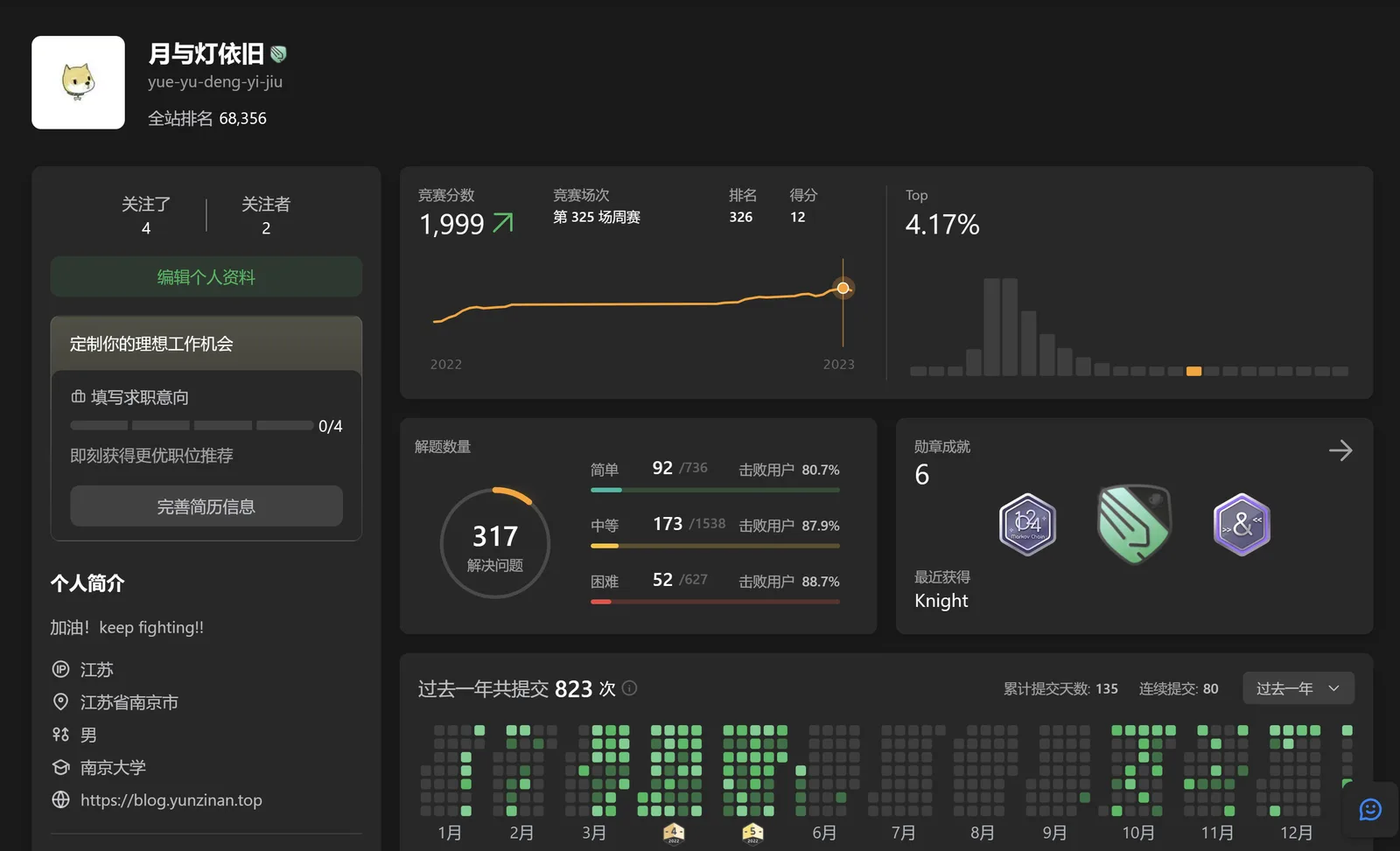
I also restarted weekly LeetCode contests, achieved my first all-accepted contest, and successfully reached the Knight level.
-
I also kept recording my problem-solving ideas and solutions on my personal website, while updating my class notes there as well.
Overall, my academic performance this semester was still good, but there were also regrets. For example, there was once a very tempting undergraduate innovation project in front of me, led by Professor Feng from the Software School, about brain-computer interfaces. After consulting the teacher, I had to give it up because I could not spare more than five hours per week. Another example is scholarships: because transferring majors meant I had not completed some courses, I was not eligible even though the other conditions were satisfied. For sophomore students, transferring majors is harder and requires greater sacrifice. Many activities and projects can only give way to heavy coursework.
Keep going, 2023. Get over this hurdle. Finally, I will encourage myself with the words of Su Haitao, a senior from the 2019 class of the School of Chemistry: with absolute strength, seize fate by the throat.