Annotated Papers
Foundations: Image Generating Models
这一节只保留后文需要反复引用的生成模型、条件控制、RL post-training 和 reward modeling 基础。
Diffusion Models
✅ Paper Title: Denoising Diffusion Probabilistic Models [1] TL;DR: 提出了 DDPM 的前向加噪和反向去噪训练范式,是后续 diffusion image generation/editing 的基本公式来源。 ✅ Paper Title: Denoising Diffusion Implicit Models [2] TL;DR: 用非马尔可夫/确定性采样路径加速 diffusion sampling,也为 DDIM inversion 和图像编辑中的内容保持提供基础工具。 ✅ Paper Title: High-Resolution Image Synthesis with Latent Diffusion Models [3] TL;DR: 将扩散过程移到 autoencoder latent space 中,大幅降低高分辨率图像生成和编辑的训练、采样成本。 ✅ Paper Title: Scalable Diffusion Models with Transformers [4] TL;DR: 用 transformer patch denoiser 替代 U-Net,说明 diffusion backbone 可以沿着 transformer scaling law 扩展。 ✅ Paper Title: Qwen-Image-2.0 Technical Report [5] TL;DR: 代表近期大规模 multimodal image generation/editing 系统,可作为前沿 diffusion/flow-style 图像基础模型的背景材料。
Flow Matching Models
✅ Paper Title: Flow Matching for Generative Modeling [6] TL;DR: 将生成建模表述为学习从 base distribution 到 data distribution 的连续向量场,是 flow matching 的核心理论基础。 ✅ Paper Title: An Introduction to Flow Matching and Diffusion Models [7] TL;DR: 系统梳理 flow matching 与 diffusion 的联系,适合在综述中作为统一 notation 和直觉解释。
Special Note: DiffAE
✅ Paper Title: Diffusion Autoencoders: Toward a Meaningful and Decodable Representation [8] TL;DR: 将图像分解为 semantic code 和 stochastic code,为身份保持、属性编辑和人脸 relighting 提供可控的 latent 表示。
This paper is interesting in that it finds out that if adding a sementic embedding as additional condition during diffusion model denoising, the latent diffusion embedding will be decoupled to that semantic, which can therefore be used as a way to disentangle certain semantics from latent.
Special Note: RL, Reward Modeling, and Post-Training
✅ Paper Title: Flow-GRPO: Training Flow Matching Models via Online RL [9] TL;DR: 将 flow sampler 改写为可优化的随机策略,并用 group-relative reward 进行在线 RL post-training。
This paper makes it possible for flow models to do onlien GRPO training. It first propose the protocol of how to translate flow model training process to Markov Decision Process. Besides, it solve the problem that flow models are definite in generation and thus cannot brining variance of rollout, which is the essential point for GPRO to improve. It also propose a engineering finding that during RL training, models do not necessarily need to generate through full steps(say 40 steps), but only 25% steps rollout could be useful for RL training, which saves training time by a large margin.
✅ Paper Title: ImageReward: Learning and Evaluating Human Preferences for Text-to-Image Generation [10] TL;DR: 学习人类偏好的 text-to-image reward model,是后续图像生成 RL 和自动评价的重要基础。
ImageReward is an early exploration of RLHF to T2I image generation models. It introduces a regressive reward model finetuned on BLIP with a 137k human preferences dataset. Then it adds a loss form in diffusion training objectives to incorporate reward signals.
✅ Paper Title: SpatialReward: Verifiable Spatial Reward Modeling for Fine-Grained Spatial Consistency in Text-to-Image Generation [11] TL;DR: 针对空间关系构造可验证 reward,可用于讨论细粒度 layout、位置和多主体一致性的奖励设计。
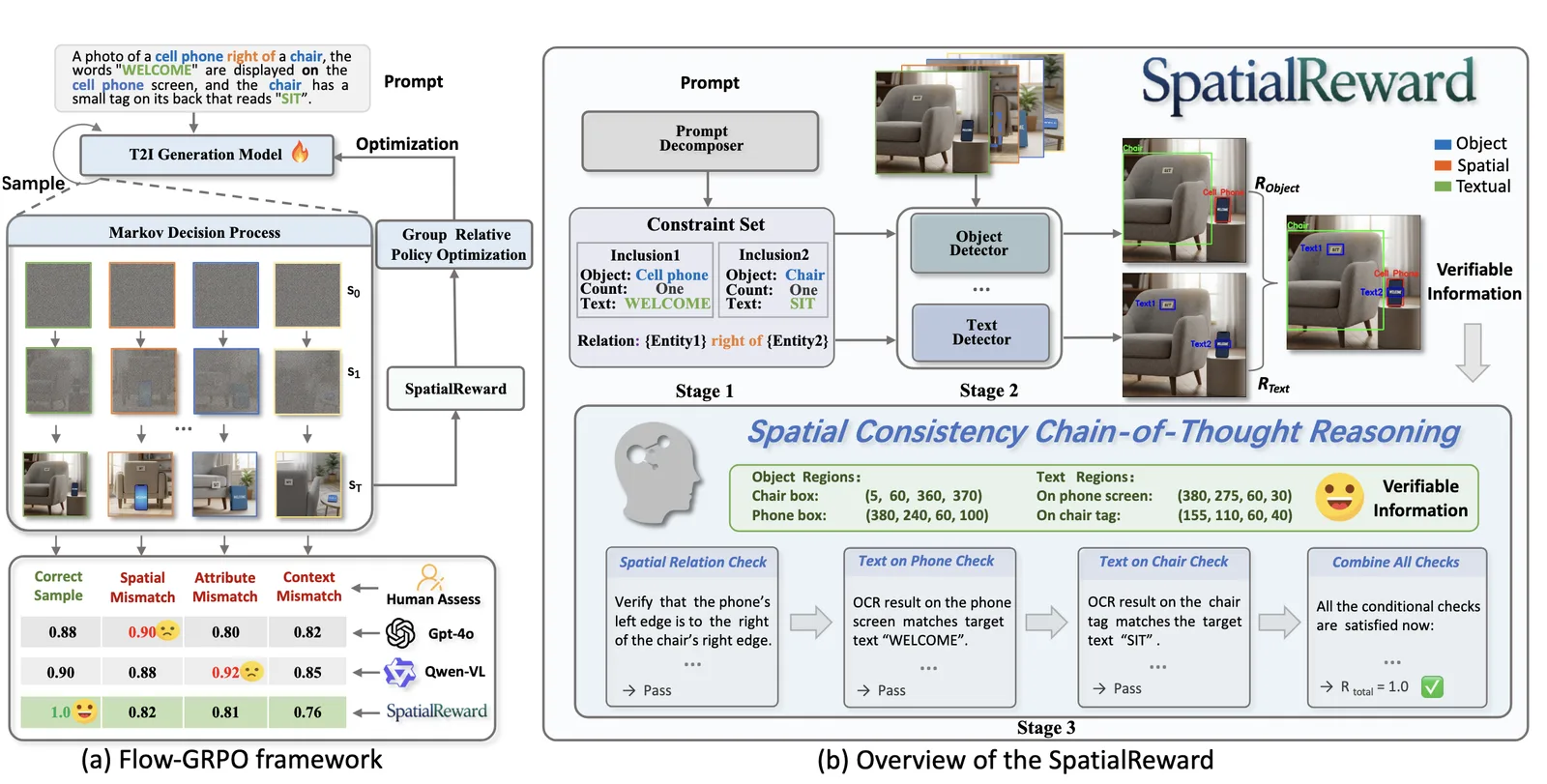
SpatialReward proposes a verifiable reward model for fine-grained evaluation of spatial layouts. It distills GPT-4o to Qwen2.5-VL-7B to teach student model to accurately extract core meta-attributes from unrestricted text prompts. The authors claim that directly using a VLM to grade online rollout images w.r.t. the fulfillment of those meta-attributes is sub-optimal, therefore they turn to use multiple off-the-shelf CV detectors to estimate rollout images’ meta-attributes, including position, angle, depth, color and number of objects. Besides, they also utilize OCR models to evaluate text generation precision. with both rollout meta-data from generated images and GT meta-data from prompt, a VLM could perform CoT reasoning to aggregate the results into final score.
✅ Paper Title: Trust Your Critic: Robust Reward Modeling and Reinforcement Learning for Faithful Image Editing and Generation [12] TL;DR: 关注 reward model 鲁棒性和 faithful editing,对后文 instruction-following editing 的 RL 训练有直接关联。
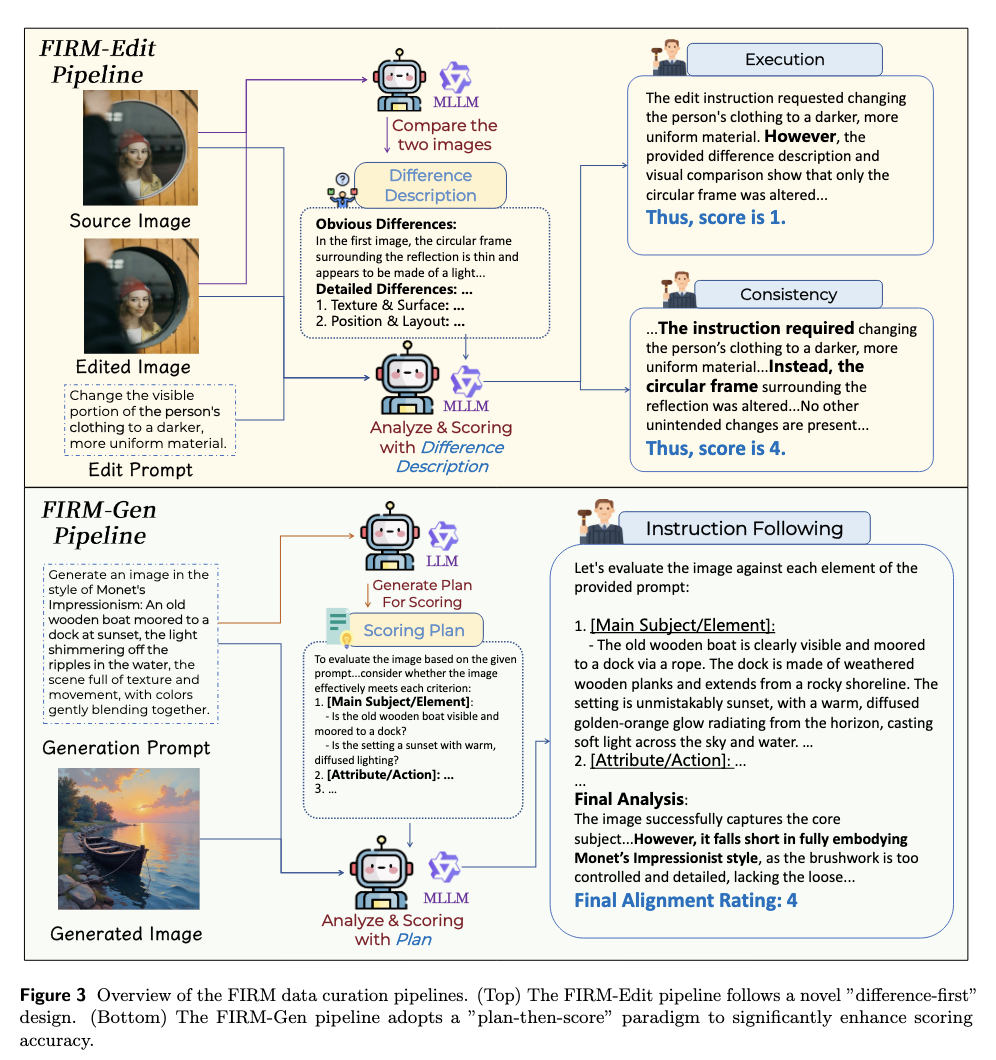
This paper proposes 4 dimension of rewards in image editing & generation: execution and consistency in editing and instruction following and image quality in T2I generation. Then it leverages powerful MLLMs as evaluators to generate breakdown principles w.r.t. input. Then another MLLM acts as the principle checker to generate final score. Using this strategy, it finetunes a Qwen3-VL-8B as the reward model, which is evaluated and validated by human preference dataset. Finally it performs online RL(Edit-R1 for Qwen-Edit and DiffusionNFT for SD3.5) to validte their method.
✅ Paper Title: Leveraging Verifier-Based Reinforcement Learning in Image Editing [13] TL;DR: 将 verifier-based reward 引入图像编辑,说明 editing model 可以通过可检查目标进行强化学习优化。
Edit-R1 is a framework that builds CoT verifier-based reasoning reward model, which is then used for online RL training. It curates reward dataset by first generating edited images by multiple image generation models, then utilizes a VLM to provide breakdown principles, which is then validated during CoT to generate final score. Using this reward dataset to SFT the reward model as the cold-start, Edit-R1 then proposes GCPO to align pointwise RM with pairwise human pereference datasets. Later the RRM model can be used in downstream RL training for image editing models.
✅ Paper Title: EditScore: Unlocking Online RL for Image Editing via High-Fidelity Reward Modeling [14] TL;DR: 为 image editing 构造更高保真的 reward model,使在线 RL 能更稳定地优化编辑质量和指令一致性。
EditScore first proposes an EditReward bench from 3k human annotations considering prompt following, consistency, and overall quality. Then it finetunes a series of Qwen-VL models by distilling scoring ablity of GPT-4.1. Its benchmarking results shows that in terms of reward model of image editing, “even the largest open-source VLMs fail to provide an effective learning signal”. Their proposed finetuned Qwen-VL-7B model could achieve competable performance with GPT-5, via the avg@4 strategy.
✅ Paper Title: SFT, RL, and On-Policy Distillation Through a Distributional Lens [15] TL;DR: 从 distributional 角度解释 SFT、RL 和 on-policy distillation,可作为生成模型 post-training 的概念补充。
This blog post explains and analyzes SFT, RL and OPD in distribution transformation perspective, pointing out catastrophic forgetting problem in SFT, and explains why RL and OPD could do better on this.
Topic 1: Group Portrait Editing
这一节可以围绕多主体身份保持、主体区分、插入/删除/操控、群体 harmonization 和 instruction following 展开。
Task-Specific Group Portrait Editing
✅ Paper Title: GroupDiff: Diffusion-based Group Portrait Editing [16] TL;DR: 专门面向群体合照编辑,重点处理多人物编辑中的身份保持、局部修改和整体一致性问题。
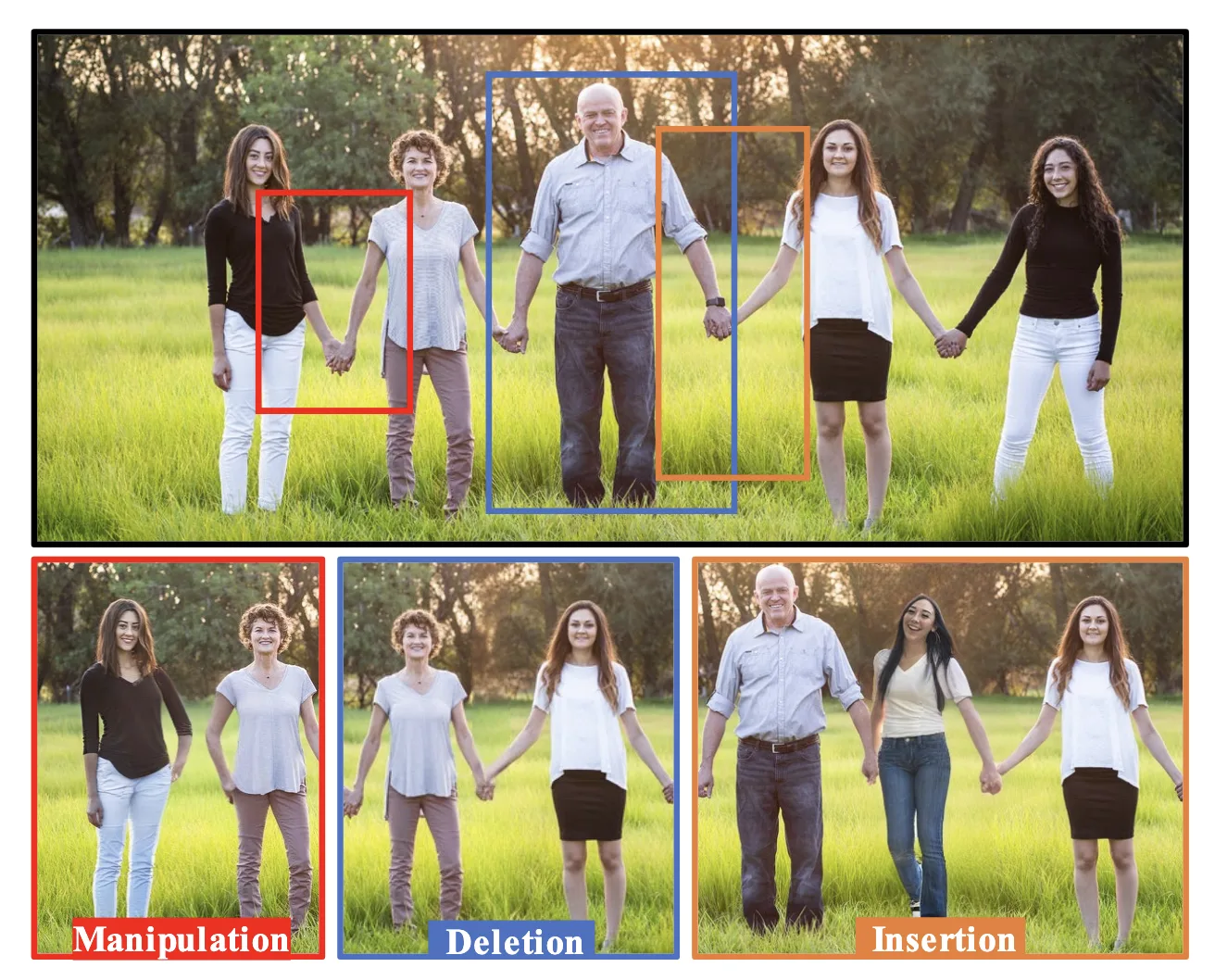
GroupDiff reformulates the problem of group image editing as an impainting task. Therefore transforms group images to (original image, masked image) task for training diffusion models to impaint. Conditions include exemplar images segmented from original image(for single subject ID-consistency) and masked oringinal group image(masked to learn the interaction w/ subjects) and pose skeleton as interaction hint.
This paper targets most towards ID consistency (inter-subject and intra-subject) by attention mechnism and controllability via mask-impaint training protocol and bbox+pose as conditions. It should be seen as the primitive work in this area, as it fails to generate harmonic target image(considering lighting and shadows, interation artifacts).
✅ Paper Title: Insert Anyone: High-fidelity Full-body Photo Insertion via Dual-branch Adapters [17] TL;DR: 针对全身人物插入任务设计双分支 adapter,同时考虑目标人物身份/外观保持和场景融合。
Insert Anyone focus on human insertion task in group portrait image. It adds LoRA adaptors to pretrained diffusion backbone by training impainting task of (masked, reconstructed) image pairs alike GroupDiff. Besides, It strangthens ID-consistency and Appearance consistency of the inserted subject by encoding features as conditions in generation by cross-attention mechnism.
✅ Paper Title: Ingredients: Blending Custom Photos with Video Diffusion Transformers [18] TL;DR: 使用 video diffusion transformer 融合自定义照片素材,可用于讨论多主体/多素材组合生成中的 temporal 或 structural consistency。
This paper resembles Insert Anyone as it also curates a dataset with SAM segmented masks indicating different Face-ID in the composite image from video clips. These Face-IDs are then utilized to train an ID router that maps latent embedding patches to their correspoding FaceID region, therefore disentangling ID information in reference images and alliveating ID blending. However the result is pretty bad, indicating its inferior performance.
✅ Paper Title: SmartPhotoCrafter: Unified Reasoning, Generation and Optimization for Automatic Photographic Image Editing [19] TL;DR: 将推理、生成和优化统一到自动摄影图像编辑流程,可作为 instruction-driven portrait/group editing 的系统级方法。
SmartPhotoCrafter improves asthetic and photorealistic image editing by proposing an artist-critic dual module that the artitist model edits input image according to suggestions generated by critic model as a loop.
It first pre-train both artist(Qwen-Image-Edit) and critic(Qwen2.5-VL-7B) model to make the artist learn to edit according to suggestions, and make the critic learn to give editing suggestions. It then goes on to fine-tune the pipeline to make the artist understand to edit based on critics last hidden repr. instead of text outputs. Finally, it utilize online RL methods(GRPO for VLM critic and DiffusionNFT for DiT artist).
To evaluate quality of generated images, this work extracts photographic properties, such as exposure, contrast, saturation, and CCT to compare with GT.
ID Consistency and Multi-ID Disentanglement
✅ Paper Title: MOSAIC: Multi-Subject Personalized Generation via Correspondence-Aware Alignment and Disentanglement [20] TL;DR: 针对多主体个性化生成提出 correspondence-aware alignment 和 disentanglement,核心问题是避免不同人物身份混淆。
MOSAIC tackles the problems of identity blending and attribute leakage in multi-subject image generation by the key insight that models should know exactly whhich regions in the generated image should attent to which parts of each reference.
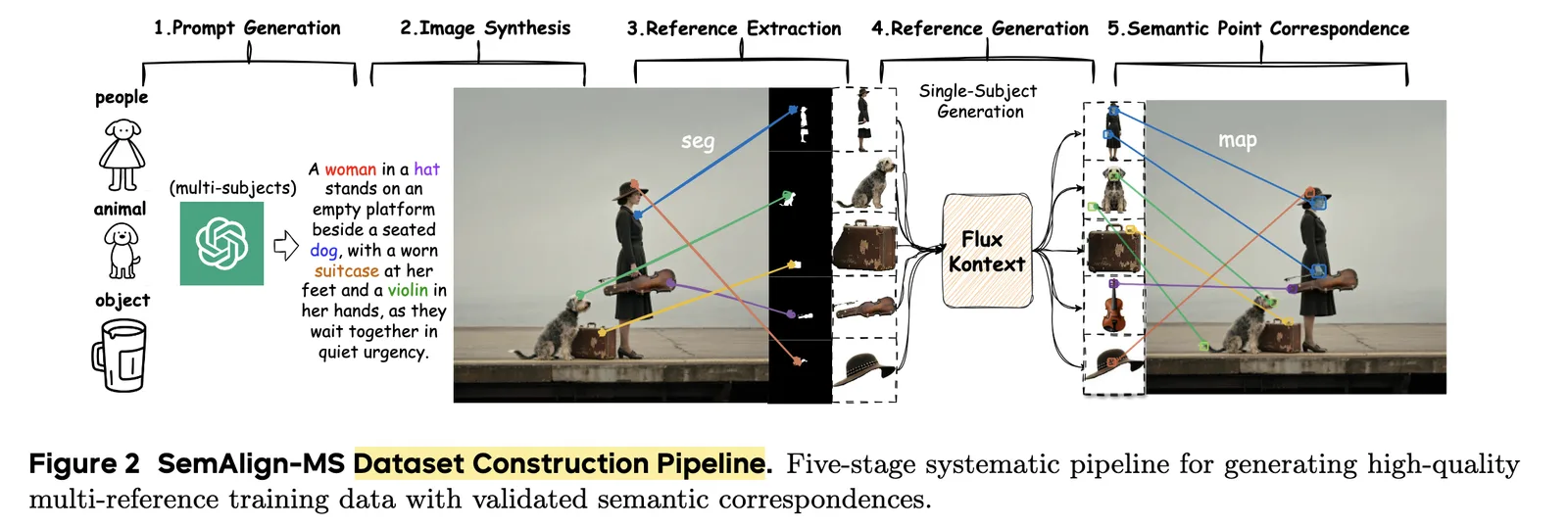
It curates a 200k synthesized image dataset, using GPT-Image to generate composite image and Flux-Kontext to generate view-corrected frontal reference images. With that, the base diffusion model is finetuned with the intra- and inter- subject attention alignment loss to teach the model to assign reference image to attend to corresponding location in composite latent image. In this way, the model learns to disenangle ID information to proper location, improving ID-consistency in group image generation task.
✅ Paper Title: ID-Patch: Robust ID Association for Group Photo Personalization [21] TL;DR: 通过更稳健的 ID association 解决群体照片个性化中的人物身份绑定和错配问题。
ID-Patch utilizes ControlNet + UNet Diffusion Model framework to realize controllable group image generation task. Instead of training the diffusion model, it fully finetunes ControlNet to adapt to a new modality named ID Patch rendering, which composites multi-subject ID image embeddings to their target positions as the geometry map. Besides geometry condition, it uses cross-attention mechnism to fuse each ID features and text prompts to diffusion model.
Not a very insightful and novel paper in its methodology.
Human Parsing, Pose, and Multi-Body Structure Priors
✅ Paper Title: Detection, Pose Estimation and Segmentation for Multiple Bodies: Closing the Virtuous Circle [22] TL;DR: 将多人检测、姿态估计和分割互相条件化,可作为 group portrait editing 的结构先验和评估工具。
BBoxMaskPose-v1 can be seen as a toolbox for creating priliminaries for group image editing as it provides multi-subject bounding box, segmentation mask, and pose estimation all-in-one.
✅ Paper Title: BBoxMaskPose v2: Expanding Mutual Conditioning to 3D [23] TL;DR: 将 bbox、mask、pose 的互条件建模扩展到 3D,有助于讨论复杂群体场景中的空间结构控制。
BBoxMaskPose-v2 extends preivous one paper to combine SAM-3D-Body to generate 3D human pose reconstruction. It could boost group image editing in complex scenes in terms 3D physics of occlusion, lighting, shading, etc. But it might accumulate error in latter workflow.
Topic 2: Layered Image Editing
这一节可以强调 layered representation 为什么能提高可编辑性:对象分离、遮挡关系、区域绑定、layer decomposition 和 layer-level RL。
Layer Decomposition and Inherent Editability
✅ Paper Title: Qwen-Image-Layered: Towards Inherent Editability via Layer Decomposition [24] TL;DR: 通过图像 layer decomposition 让生成结果天然具备可编辑性,是 layered image generation/editing 的核心代表工作。
Qwen-Image-Edit can be seen as the primitive work of this task. It first finetunes a Text-to-RGB diffusion model to Text-RGBA model. Then the model to asked to jointly predict composite image and layered images as GT. Last, It changes the input from text to image to form an image-to-Variable Layers Decomposite RGBA diffusion model.
This work fails short in that its semantic decomposition is fully-data driven. However, since layer decomposition task usually does not have the only one GT. Instead, multiple reasonable decomposition ways co-exist. Therefore pushing the model towards one solution introduces bias and hinders superior performance. Another problem is induced from the dataset. Since all layered images are created in PS(usually posters, abstract patterns instead of photographs), the gap beween synthetic images and in-the-wild images may be problematic.
✅ Paper Title: Stable-Layers: Fine-Tuning Image Layer Decomposition Models with VLM-Scored Reinforcement Learning [25] TL;DR: 用 VLM-scored RL 微调 layer decomposition 模型,说明分层表示也可以通过 reward 优化提升可用性。
This work is a follow-up work to [24] as it finetunes Qwen-Image-Layered using Flow-GRPO and improves layerization without relying on paired data. The insight lies in that there may exist multiple reasonable ground truth of decomposed layers, which encourages multi-trajectory exploration. Besides, training in RL way eliminates the need for paired supervision.
The rewarding method is quite simple: just breakdown the judging criterion into 5 dimension(semantic separation, alpha cleanliness, bg. impainting, feature distribution, content validity) and let a VLM grade each rollout.
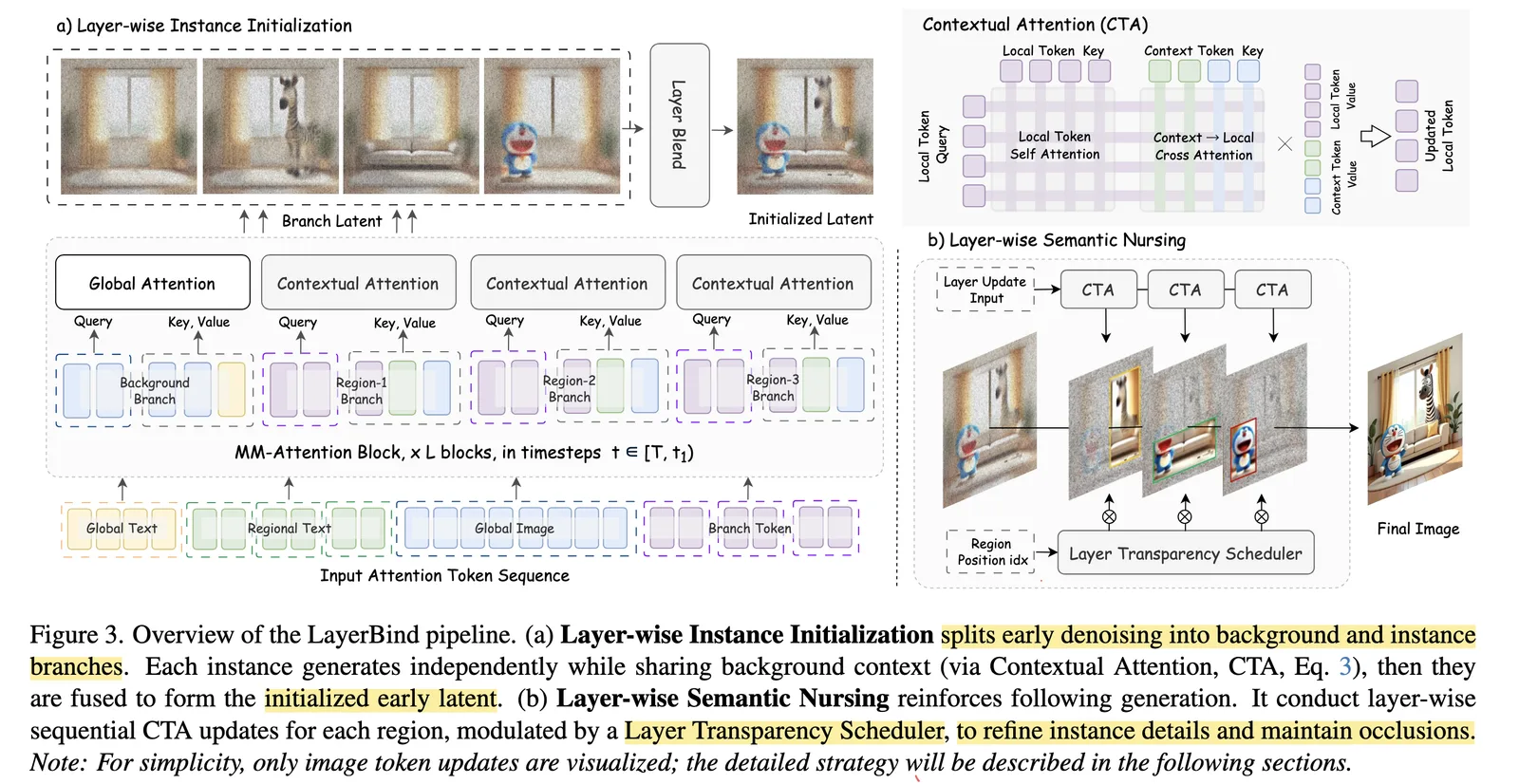
✅🏆 Paper Title: LayerBind: Layer-wise Instance Binding for Regional and Occlusion Control in Text-to-Image Diffusion Transformers [26] TL;DR: 在 diffusion transformer 中进行 layer-wise instance binding,重点解决区域控制和遮挡控制。
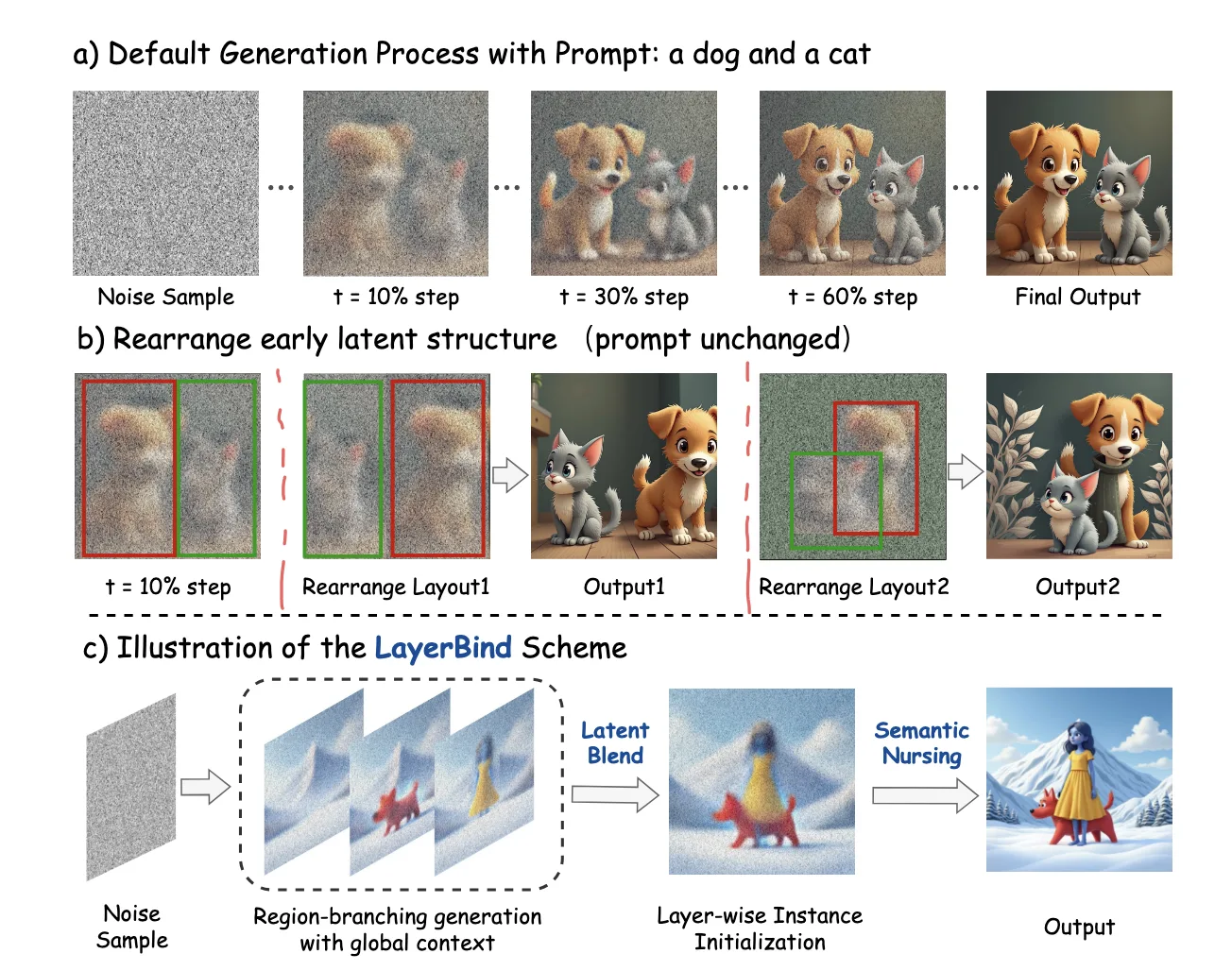
LayerBind is a training-free layer-wise image generation method that seizes that key observation: geometry layout and occlusion are set at early steps during denoising trajectory. Therefore, it is viable to manipulate each component of the composite image by isolating attention calculation to denoise indepent part of the image while sharing information through gloabal attention and contextual attetion, without modifying model weights.
Layered Human Assets and Synthetic Supervision
✅ Paper Title: SynBody: Synthetic Dataset with Layered Human Models for 3D Human Perception and Modeling [27] TL;DR: 提供 layered human synthetic data,可作为人物编辑、人体建模和遮挡分解的监督来源。 ✅ Paper Title: BEDLAM: A Synthetic Dataset of Bodies Exhibiting Detailed Lifelike Animated Motion [28] TL;DR: 大规模合成人体数据集,适合支撑全身人物编辑、pose-aware generation 和人体 relighting 的数据讨论。 ✅ Paper Title: BEDLAM2.0: Synthetic Humans and Cameras in Motion [29] TL;DR: 扩展 BEDLAM 到更复杂的人体和相机运动,为视频人物生成、编辑和 relighting 提供 synthetic supervision。
These works provides Human assets and methods to generate human assets based on rigged SMPL-X format human body assets.
Topic 3: Relighting
这一节建议先讲数据来源和 lighting representation,再从 general protocols 与 backbone models 两个角度分类方法,最后讨论 evaluation 和 real-world gap。
Dataset Collections and Data Crafting Methods
Light Stage and OLAT Capture
✅ Paper Title: Acquiring the Reflectance Field of a Human Face [30] TL;DR: 经典 light stage/reflectance field 工作,奠定了用 OLAT 采集和线性组合做人脸 relighting 的物理基础。
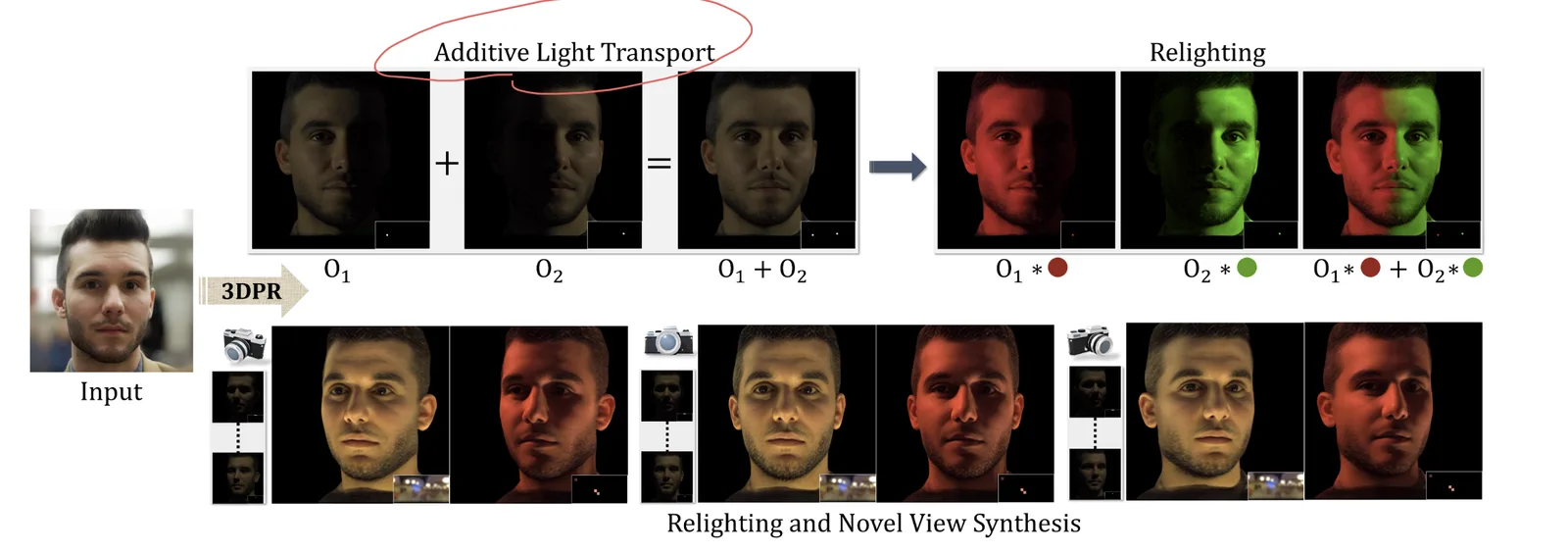
The foundation work that proposed light linearly addictivity. It is the foundation of IC-Light[31], LightLab[32], OLAT-mixing methods[33, 34].
✅🏆 Paper Title: POLAR: A Portrait OLAT Dataset and Generative Framework for Illumination-Aware Face Modeling [34] TL;DR: 构建 portrait OLAT 数据集并提出 illumination-aware 生成框架,是现代人像 relighting 数据与模型结合的代表。
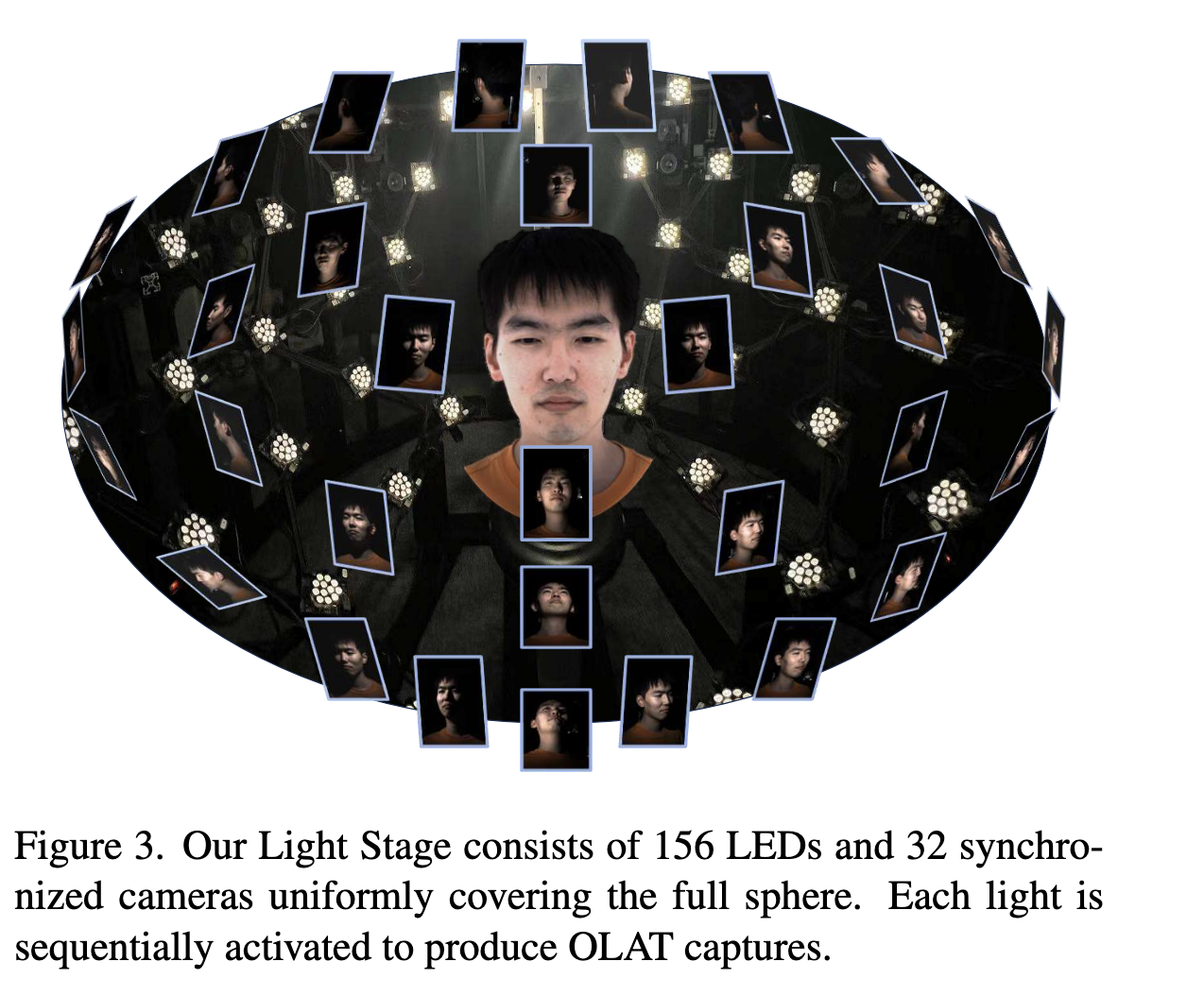
POLAR and its concurrent work 3DPR[33] provides currently two largest publicly-available OLAT datasets of multi-view, multi-expression light stage dataset.
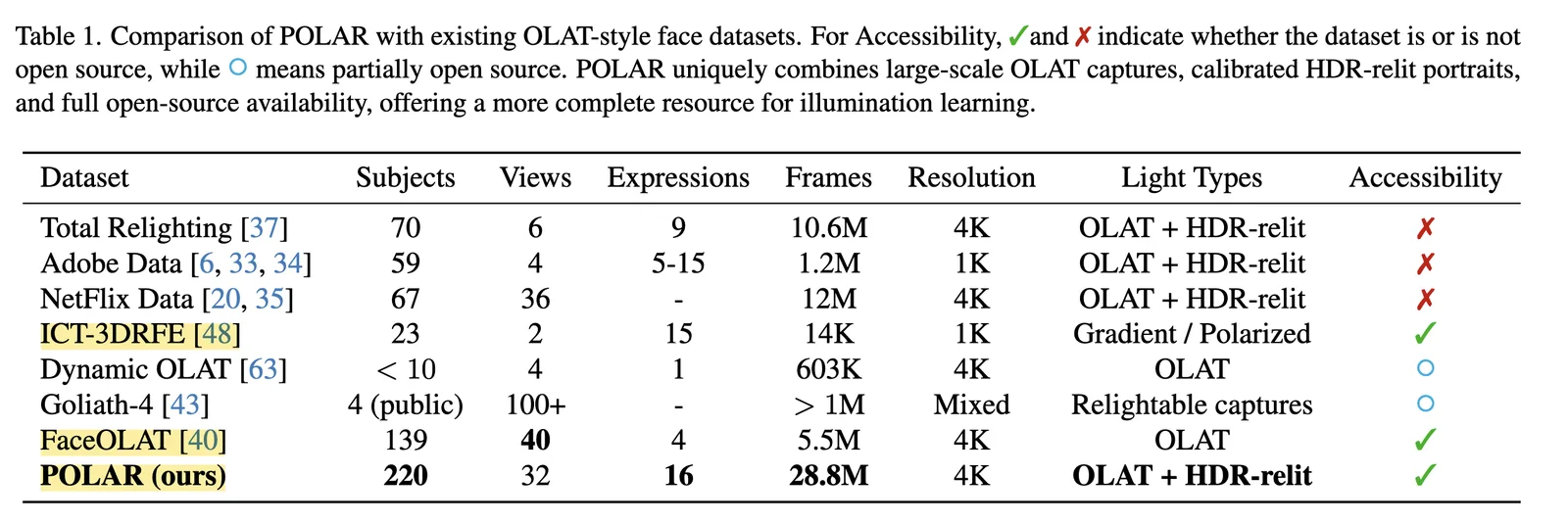
Besides the data crafting, both works seek to train a generalized OLAT image basis generator for unseen subjects. In this work, POLARNet is proposed as a UNet-based diffusion network. However the modeling is quite simple and leaves the room for improvement.
Synthetic Rendering and Data Generation
✅ Paper Title: SynthLight: Portrait Relighting with Diffusion Model by Learning to Re-render Synthetic Faces [35] TL;DR: 用 synthetic face re-rendering 训练 diffusion portrait relighting,突出合成数据缓解真实成对 relighting 数据稀缺的问题。
SynthLight proposes a end-to-end portrait relighting diffusion framework by formulating the relighting task as re-rendering synthetic faces. It utilizes Blender to render high-quality 3D head assets with Cycles renderer, 形成了 a synthesized relighting dataset consisting of 1.26M images.
Different compared to conventional reverse rendering methods that first decouples light-related intrinsics(albedo, normal map, specular, depth, etc.) and then re-render the BRDF model, SynthLight is fully data-driven as it directly maps input image and HDR envmap to relit image. To mitigate the synth-to-real gap, it adds another T2I training protocol to improve photorealism and generalization of the trained model.
✅ Paper Title: BEDLAM: A Synthetic Dataset of Bodies Exhibiting Detailed Lifelike Animated Motion [28] TL;DR: 可为 full-body relighting 和人体外观建模提供合成人体、姿态和运动数据。 ✅ Paper Title: BEDLAM2.0: Synthetic Humans and Cameras in Motion [29] TL;DR: 提供更丰富的动态人体和相机设置,适合视频 relighting 或 dynamic human relighting 的数据背景。 ✅ Paper Title: SynBody: Synthetic Dataset with Layered Human Models for 3D Human Perception and Modeling [27] TL;DR: layered synthetic human models 可用于分离人体、衣物、几何和外观,对 relighting 的分解式训练有参考价值。
In-the-Wild Data and Real-World Adaptation
✅ Paper Title: Scaling In-the-Wild Training for Diffusion-based Illumination Harmonization and Editing by Imposing Consistent Light Transport [31] TL;DR: 通过大规模 in-the-wild 训练和一致 light transport 约束实现 illumination harmonization/editing。
see annotation of this paper at other place.
✅ Paper Title: Learning a Delighting Prior for Facial Appearance Capture in the Wild [36] TL;DR: 学习 in-the-wild 人脸外观的 delighting prior,用于从自然光图像中恢复更可控的 intrinsic appearance。
OpenDelight narrows the task to only frontal human face delighting, excluding body part below frontal face, hair. It takes a phone-shot video clip as input, and generates face mesh and texture map(including diffuse, specular, and normal), which could be directly utilized for downstream tasks such as relighting.
It utilizes FaceOLAT[33] dataset and purchased Light Stage scans data, and renders with HDR envmap from Polyheaven using official relighting protocol and Blender to render, respectively. However, this work depends heavily on data instead of model&methology as it merely uses ViT encoder and convolutional decoder as the network, and by training in a reconstruction loss manner. To enhance details that are lost in ViT encoder, it trains an extra UNet for high-freqency detail restoration through LR2SR restoration manner.
✅ Paper Title: Toward Real-World Adoption of Portrait Relighting via Hybrid Domain Knowledge Fusion [38] TL;DR: 融合真实域与先验知识,重点解决 portrait relighting 从实验设置走向真实应用的 domain gap。
This work trains 3 specialized, cross-domain-aware prior models(, , ) that could relight portrait images based on different types of input images. Then these separate prior models are distilled by an explicit router to assign images that are best suited for that specific domain, then supervise the student model with its outputss as pseudo GTs.
✅ Paper Title: WildRelight: A Real-World Benchmark and Physics-Guided Adaptation for Single-Image Relighting [39] TL;DR: 提供真实世界 single-image relighting benchmark,并用 physics-guided adaptation 缩小真实数据上的性能差距。
see annotations at other place.
Lighting Representation and Control Signal
✅ Paper Title: UniLight: A Unified Representation for Lighting [40] TL;DR: 提出统一 lighting representation,可作为 HDR envmap、point light、directional light 等条件编码的综述入口。
UniLight aligns different light conditions(envmap, text descriptions, irradiance map, reference image) together to a unified embeddings space through CLIP-like contrastive learning, which facilitates flexible lighting condition input in relighting task.
✅ Paper Title: LightMover: Generative Light Movement with Color and Intensity Controls [41] TL;DR: 关注光源位置、颜色和强度的生成式控制,适合讨论可编辑 lighting parameterization。
Lightmover utilizes a pre-trained video diffusion model for single image light manipulation(displacement, light intensity, light color, etc). It takes 1)reference image, 2) object image, 3) movement map, 4) color control map, 5) intensity control map as 5 input frames to VDM, and generates relit image at sixth frame. It also introduces an adaptive token pruning method to reduce the token length while preserving accurate spatial and illumination control. Another key point for 改造ing VDM into a multi-modal condition diffuision model lies in the trick of multi-signal positional encoding, which is 从经典的 positional encoding 改造而来,通过不同维度的meta vectors 来 discern different input conditions.
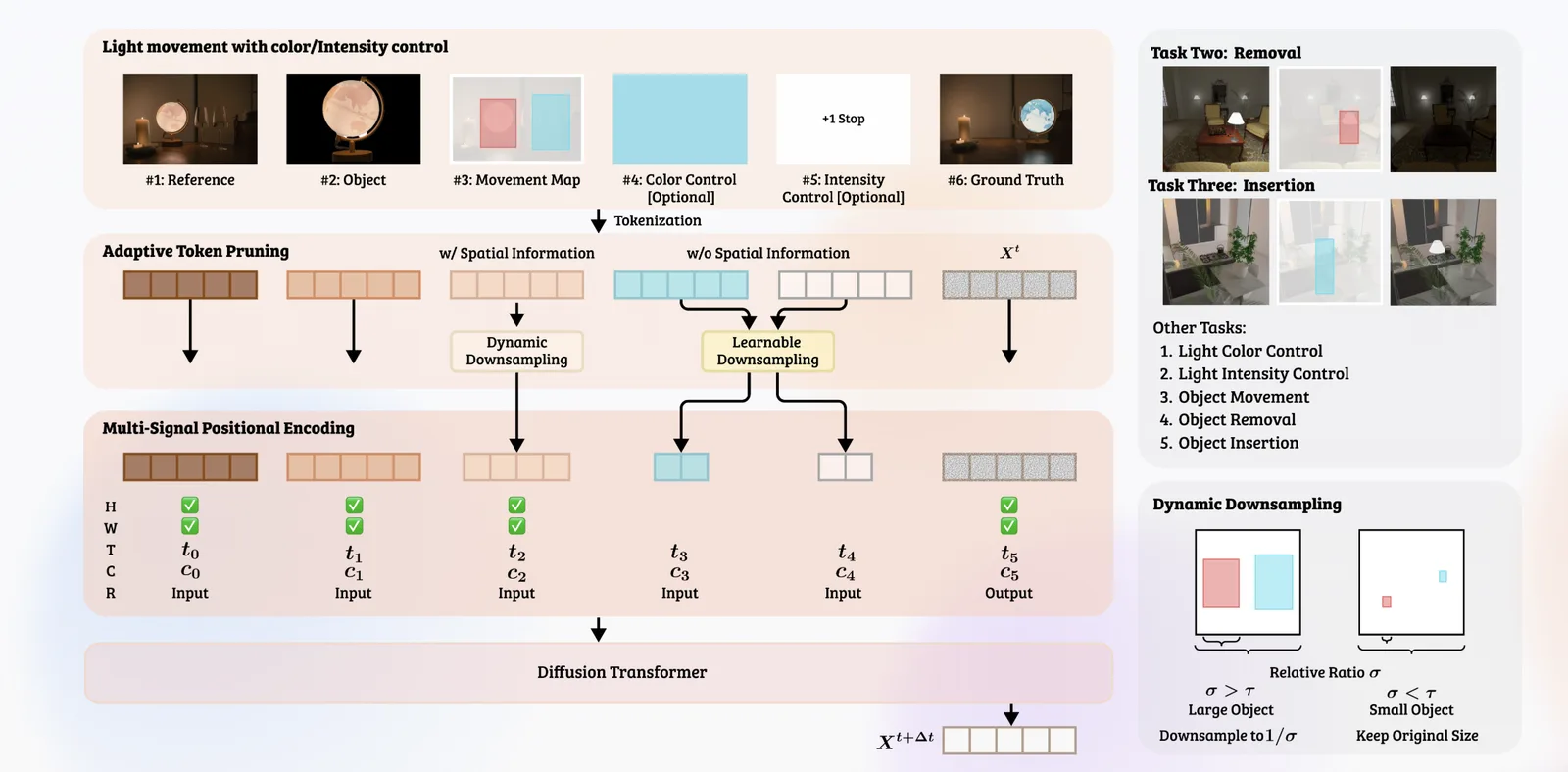
It utilizes Blender to curate a 32k lighting variation dataset(different view angle, intensity, color, etc) as the major data source. To mitigate synth-to-real gap, it also uses a comparatively small real dataset including hundreds of real captured images.
✅🏆 Paper Title: LightLab: Controlling Light Sources in Images with Diffusion Models [32] TL;DR: 用 diffusion model 控制图像中的光源,是 general image relighting/light editing 的重要代表。
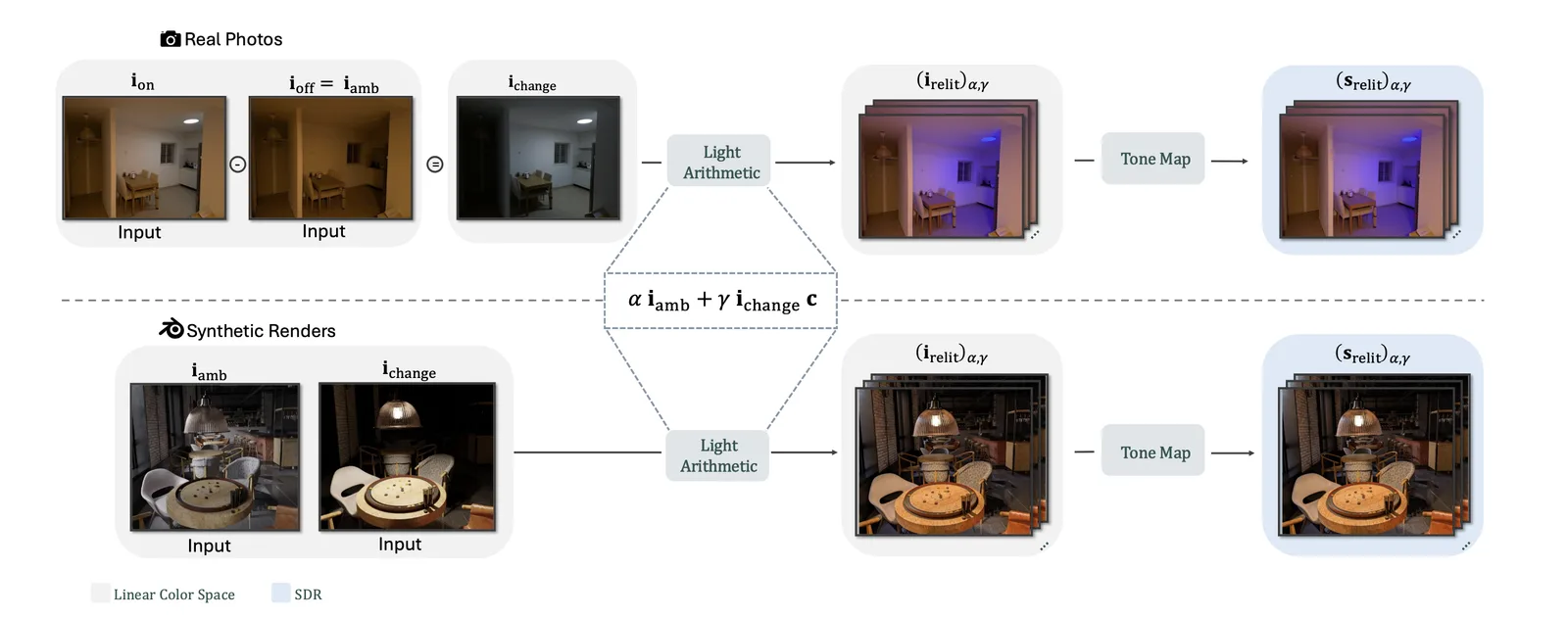
LightLab proposes a dataset curation pipeline that utilize the light linearly addictivity property to inflate relit images by mixing on- and off- images both from real photos and synthetic renders.
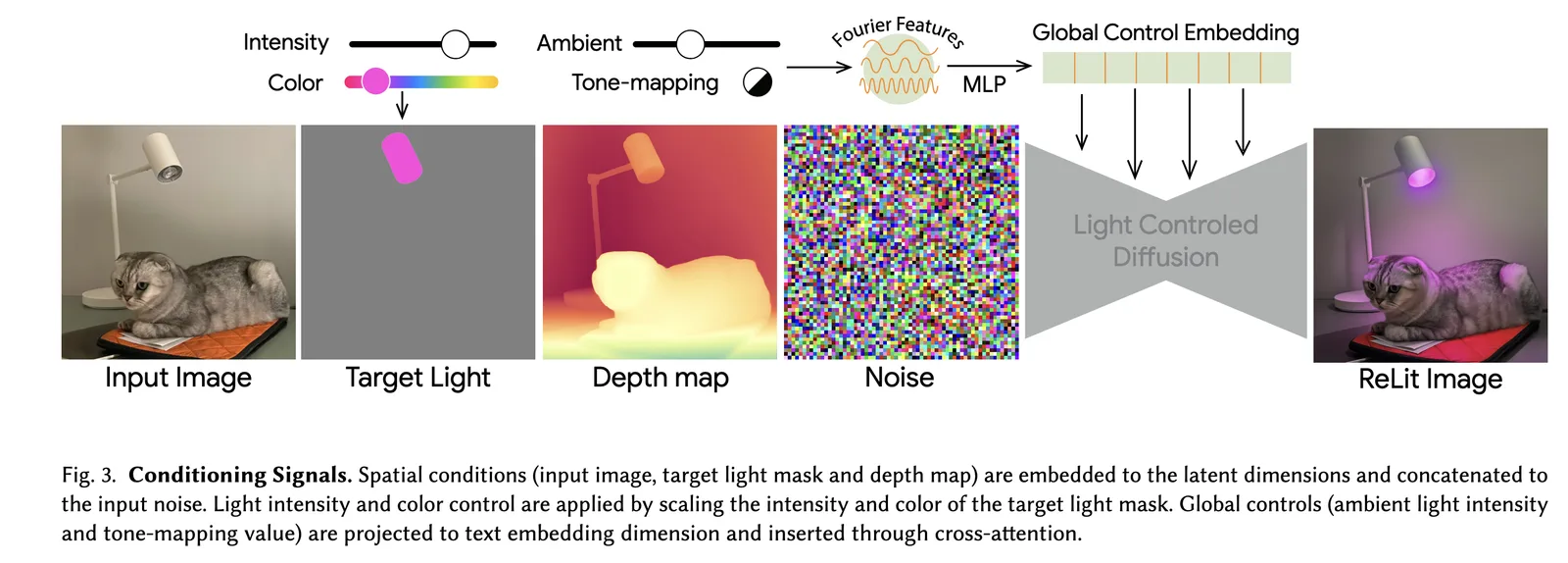
This work fine-tunes a pre-trained LDM to enable parametric control. input image, light map and extracted depth map are embedded together and concatenated to input noise, while global control such as ambient light intensity and tone-mapping value(to prevent over- or under- exposure) are projected to text embedding dim. through cross-attention.
Relighting Methods Categorized by General Protocols
Reverse Rendering and Intrinsic Decomposition
✅ Paper Title: Learning a Delighting Prior for Facial Appearance Capture in the Wild [36] TL;DR: 通过学习 delighting prior 将光照影响从人脸外观中分离出来,属于 inverse rendering/decomposition 思路。
see annotation at other place.
✅ Paper Title: UniRelight: Learning Joint Decomposition and Synthesis for Video Relighting [42] TL;DR: 联合学习视频分解和重合成,让 relighting 同时保持 temporal consistency 和物理可解释性。
see annotation at other place.
✅🏆 Paper Title: GeoRelight: Learning Joint Geometrical Relighting and Reconstruction with Flexible Multi-Modal Diffusion Transformers [43] TL;DR: 将几何重建和 relighting 联合建模,强调 normal/depth/geometry 等多模态条件在 relighting 中的作用。

GeoRelight highlights the ill-posed relight task as a 2D image ambiguously entangles 3D geometry, intrinsic appearance, and illumination. To improve physical consistency, GeoRelight re-formulate the relighting task as a joint modeling task to model segmentation, albedo, normal, iNOD(invented as unbiased 3D depth repr.) and relit image in a MM-DiT model.
Using to indicate which modals are input conditions and which are predicted outputs, it enables a flexible input and output scheme, and faciliate the training process to use different types of datasets including Light Stage images with light conditions, in-the-wild images, and synthesized images.
✅🏆 Paper Title: 3DPR: Single Image 3D Portrait Relighting with Generative Priors [33] TL;DR: 利用生成先验从单张图像恢复可 relight 的 3D portrait 表示,连接 single-image relighting 与 3D reconstruction。
This work provides a massive public dataset of multi-view, multi-expression human portrait light stage dataset named FaceOLAT. It further trains a generalizable model 3DPR using StyleGAN as the generative backbone. It incorporates an EG3D face prior to generate face geometry, then trained lightweight MLPs to learn reflectance w.r.t face embeddings, light conditions, view angles, etc.
OLAT Mixing and Reflectance Field Modeling
✅ Paper Title: Acquiring the Reflectance Field of a Human Face [30] TL;DR: 用一组单光源响应线性组合任意光照,是 OLAT mixing 的经典物理协议。
see annotation at other place.
✅ Paper Title: POLAR: A Portrait OLAT Dataset and Generative Framework for Illumination-Aware Face Modeling [34] TL;DR: 将 OLAT 数据与生成模型结合,支持 illumination-aware face modeling 和可控人像 relighting。
see annotation at other place.
Physics-Inspired and Light-Transport-Constrained Methods
✅🏆 Paper Title: PI-Light: Physics-Inspired Diffusion for Full-Image Relighting [44] TL;DR: 将物理启发约束注入 diffusion full-image relighting,强调阴影、明暗和全局一致性。
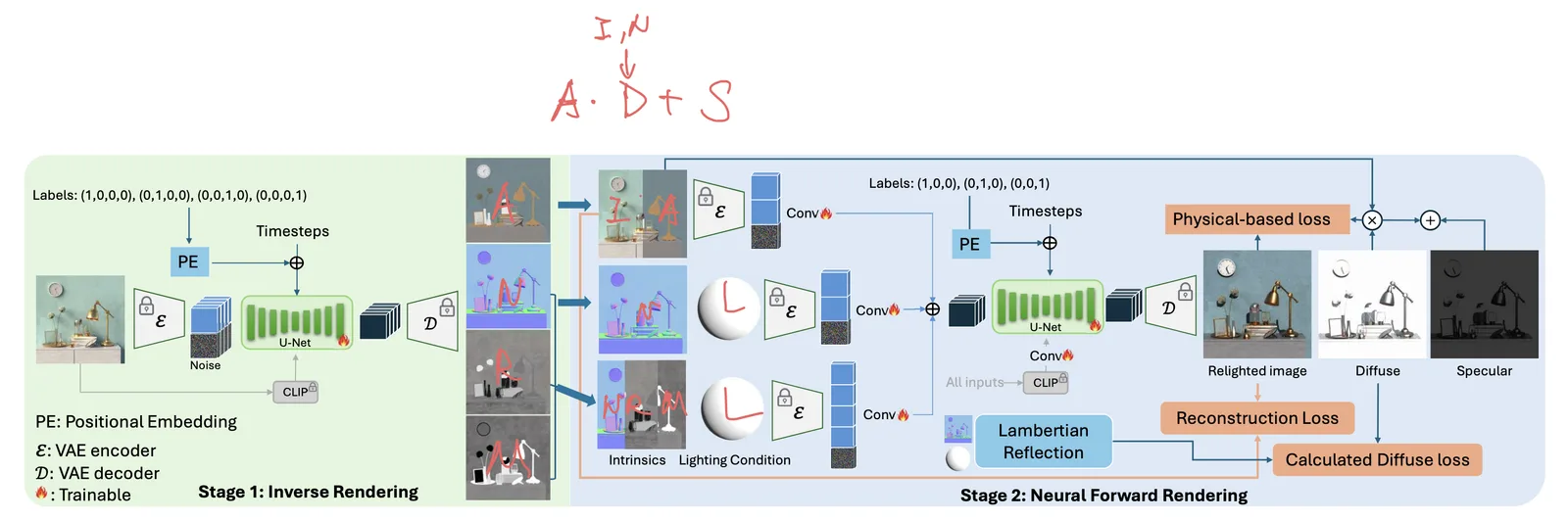
-Light utilize the conventional Phong BRDF model that formulates lighting as
where refer to albedo, diffuse, and specular. This is a typical work of reverse rendering method, which first predicts the intrinsics like albedo, normal, roughness, metallic. The extracted intrinsics from Stage1 are then fed into Stage2 U-Net Diffusion Model as conditions to jointly generate relit image, diffuse, and specular. Then the approximate BRDF equation could constrain the model output to obey the physical lighting rule, generating more photo-realistic relit image.
This work utilize Blender to synthesize a huge dataset with 10k+ object assets from Objaverse and 300 scene assets from BlenderKit. Instead of using original HDR envmap, it utilize a semi-sphere relit gray ball as reference image, which can been seen as a trade-off between full 表达能力 of HDR envmap and easy and user-friendly controllability of light condition.
✅🏆 Paper Title: Scaling In-the-Wild Training for Diffusion-based Illumination Harmonization and Editing by Imposing Consistent Light Transport [31] TL;DR: 用 consistent light transport 约束提升 diffusion illumination editing 的真实感和一致性。
IC-Light is the most influential work of methods utilizing light linearly addictivity rule[30] as physical guidance in image relighting. Zhang et al. claims that “Preserving image details and intrinsic properties requires not only content generation but also discriminative and decompostion cababilities from the model to analyze image constituents.” Therefore, the light transport consistency is proposed using the aforementioned rule:
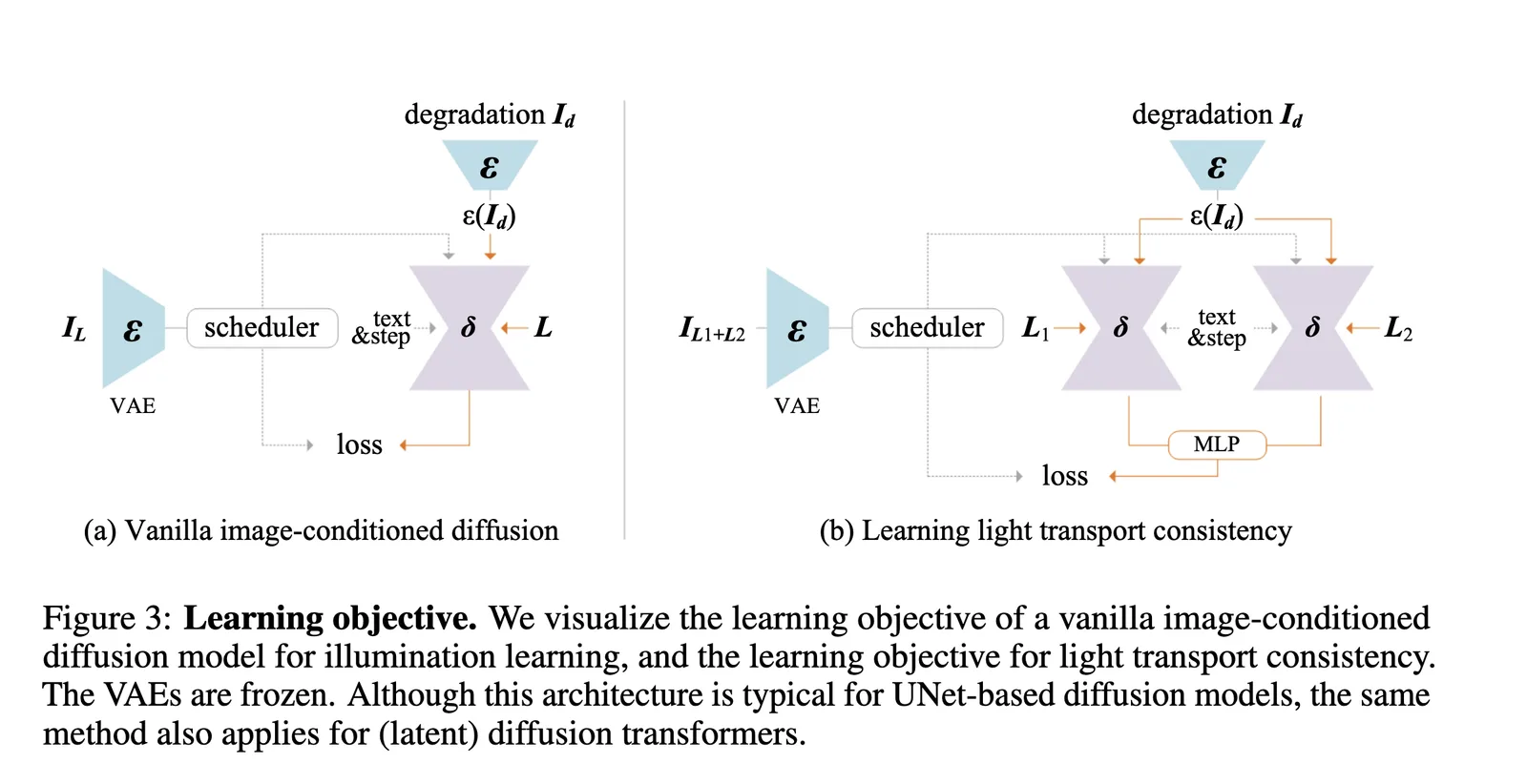
Another idea to utilize the light linearly addictivity rule is like [32], which inflates synthesized data using the rule, instead of using it as the supervision during training.
✅ Paper Title: UniLumos: Fast and Unified Image and Video Relighting with Physics-Plausible Feedback [45] TL;DR: 通过 physics-plausible feedback 统一快速图像和视频 relighting。
✅ Paper Title: WildRelight: A Real-World Benchmark and Physics-Guided Adaptation for Single-Image Relighting [39] TL;DR: 用 physics-guided adaptation 处理真实世界 relighting 数据与模型泛化问题。
The authors claim that for image and video relighting task, “Generic generation scores (e.g., FID, LPIPS) fail to capture lighting-specific errors such as shadow misalignment, intensity mismatch, or incorrect light direction.” Therefore they proposed Lumos Score, which utilize Qwen2.5-VL to to classification on 6 dimensions of properties(direction of light, light source type, light intensity, color temperature, light changes, optical). Lumos Score generates a structural light condition, but it’s vague and prone to be noisy as the boundry of categories(e.g. cool vs. neutral temperature) is hard to distinguish by a VLM. This annotation system could not only be used as the lighting condition of the flow model, but also be used as metrics for VLM judges during evaluation.
Besides Lumos Score, this work also proposes a physics-plausible feedback, which is similar to [38], where source image/video and relit image/video should share the same intrinsics(e.g. albedo, depth, normal) as a constraint for consistent generation.
Generative Light Editing and Harmonization
✅ Paper Title: LightLab: Controlling Light Sources in Images with Diffusion Models [32] TL;DR: 将光源编辑作为 diffusion image editing 任务,支持改变图像中的光源效果。
see annotation at other place.
✅ Paper Title: LightMover: Generative Light Movement with Color and Intensity Controls [41] TL;DR: 允许用户控制光源移动、颜色和强度,强调交互式 lighting editability。
see annotation at other place.
✅ Paper Title: SmartPhotoCrafter: Unified Reasoning, Generation and Optimization for Automatic Photographic Image Editing [19] TL;DR: 可作为摄影图像自动优化中的 lighting-aware editing 系统参考。
see annotation at other place.
Reinforcement Learning and Reward-Guided Relighting
✅ Paper Title: BiPR-RL: Portrait Relighting via Bi-directional Consistent Deep Reinforcement Learning [46] TL;DR: 用双向一致性强化学习优化 portrait relighting,直接对应 relighting 中 RL 训练策略。
BiPR-RL reformulate image relighting task from image generation to image editing process during denoising steps of diffusion process. It uses distance metrics as rewards signals to supervise the model.
✅ Paper Title: Flow-GRPO: Training Flow Matching Models via Online RL [9] TL;DR: 虽不是 relighting 专门方法,但可作为用 lighting reward post-train flow relighting model 的算法基础。
see annotation at other place.
✅ Paper Title: EditScore: Unlocking Online RL for Image Editing via High-Fidelity Reward Modeling [14] TL;DR: 可为 relighting 设计高保真 reward 提供参考,尤其是目标光照、身份保持和视觉真实感的联合评价。
see annotation at other place.
✅ Paper Title: Trust Your Critic: Robust Reward Modeling and Reinforcement Learning for Faithful Image Editing and Generation [12] TL;DR: 可用于讨论 relighting reward model 的鲁棒性,避免 reward hacking 和不忠实编辑。
see annotation at other place.
Relighting Methods Categorized by Backbone Models
Image Diffusion Models
✅ Paper Title: DiFaReli: Diffusion Face Relighting [47] TL;DR: 早期 diffusion face relighting 代表,用扩散先验进行单图人脸重光照。
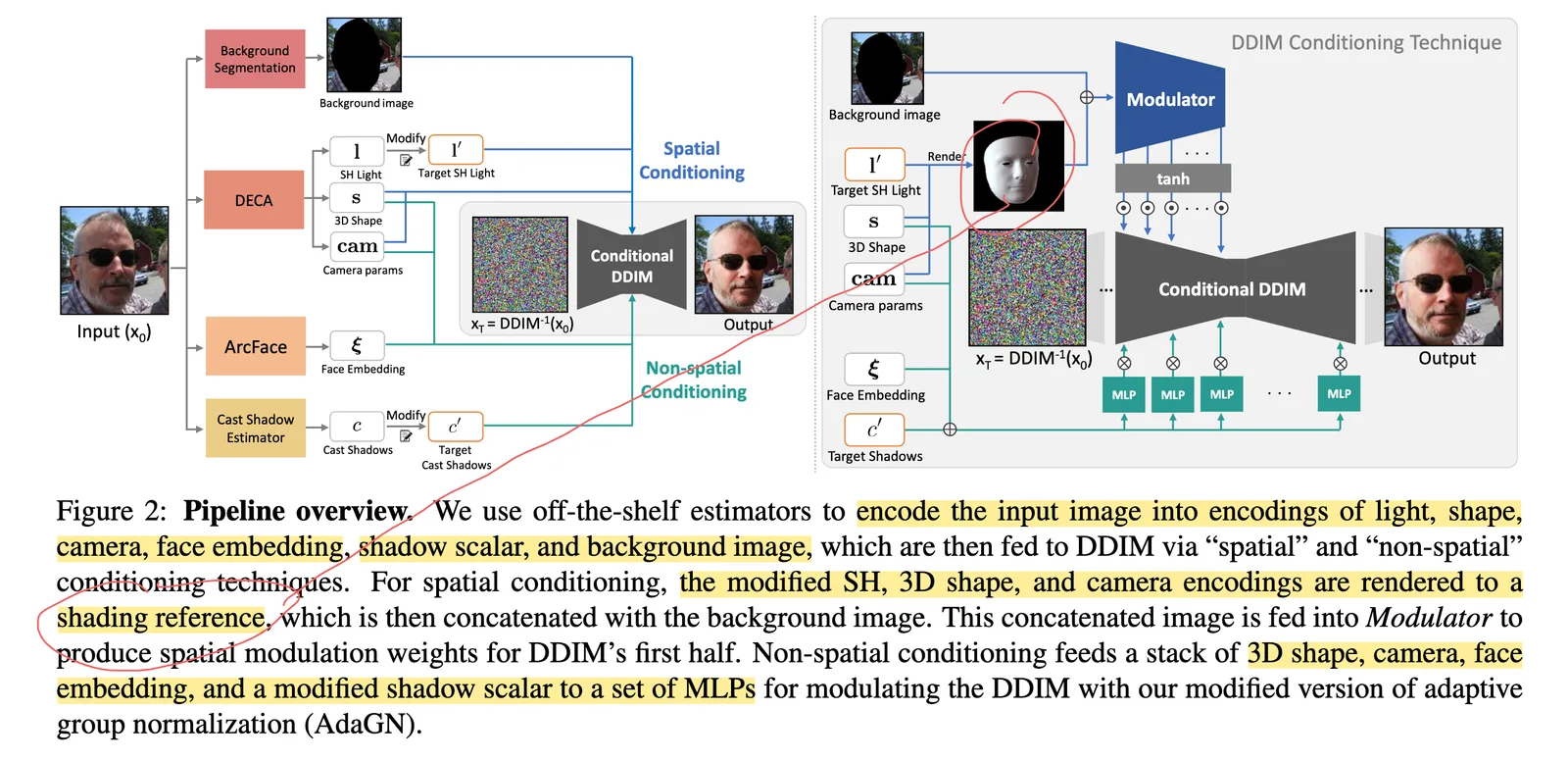
DiFaReli is a early work of human portrait relighting. Instead of estimating intrinsics from source image, it utilizes off-the-shelf decoders to decode light, shape, camera, face embedding, shadow scalar and background images. The relighting task is therefore reformulated as a conditional generation task, i.e. to generate original image from estimated conditions. These conditions are split into spatial and non-spatial conditions for different condition techniques to DDIM network.
- Paper Title: DiFaReli++: Diffusion Face Relighting with Consistent Cast Shadows [48] TL;DR: 在 DiFaReli 基础上强化 cast shadow 一致性,解决人脸 relighting 中阴影可信度问题。
✅ Paper Title: SynthLight: Portrait Relighting with Diffusion Model by Learning to Re-render Synthetic Faces [35] TL;DR: 用合成人脸 re-rendering 监督 diffusion relighting,是 synthetic-to-real portrait relighting 的关键方法。
see annotation at other place.
✅ Paper Title: PI-Light: Physics-Inspired Diffusion for Full-Image Relighting [44] TL;DR: image diffusion backbone 上加入物理启发机制,实现全图范围的 relighting。
see annotation at other place.
✅ Paper Title: LightLab: Controlling Light Sources in Images with Diffusion Models [32] TL;DR: diffusion-based light source control,适合作为通用光照编辑而非仅人像 relighting 的方法。
see annotation at other place.
✅ Paper Title: Scaling In-the-Wild Training for Diffusion-based Illumination Harmonization and Editing by Imposing Consistent Light Transport [31] TL;DR: diffusion illumination harmonization/editing 的 in-the-wild 大规模训练代表。
see annotation at other place
Video Diffusion Models
✅ Paper Title: GenLit: Reformulating Single-Image Relighting as Video Generation [49] TL;DR: 将单图 relighting 重新表述为视频生成问题,利用 video generation prior 产生连续光照变化。
GenLit reformulate the single image relighting task as image-to-video generation by keeping the scene and object static while generating the lighting changes(motion) by controlling the position of the light source(point light).
It utilizes a frozen Stable Video Diffusion model as backbone, finetunes a ControlNet using light-moving video clips synthesized in Blender. lighting conditions are expressed as the format of sperical positions and light radiance.
✅🏆 Paper Title: UniRelight: Learning Joint Decomposition and Synthesis for Video Relighting [42] TL;DR: 面向视频 relighting 的 joint decomposition/synthesis 方法,重点处理时序一致性。
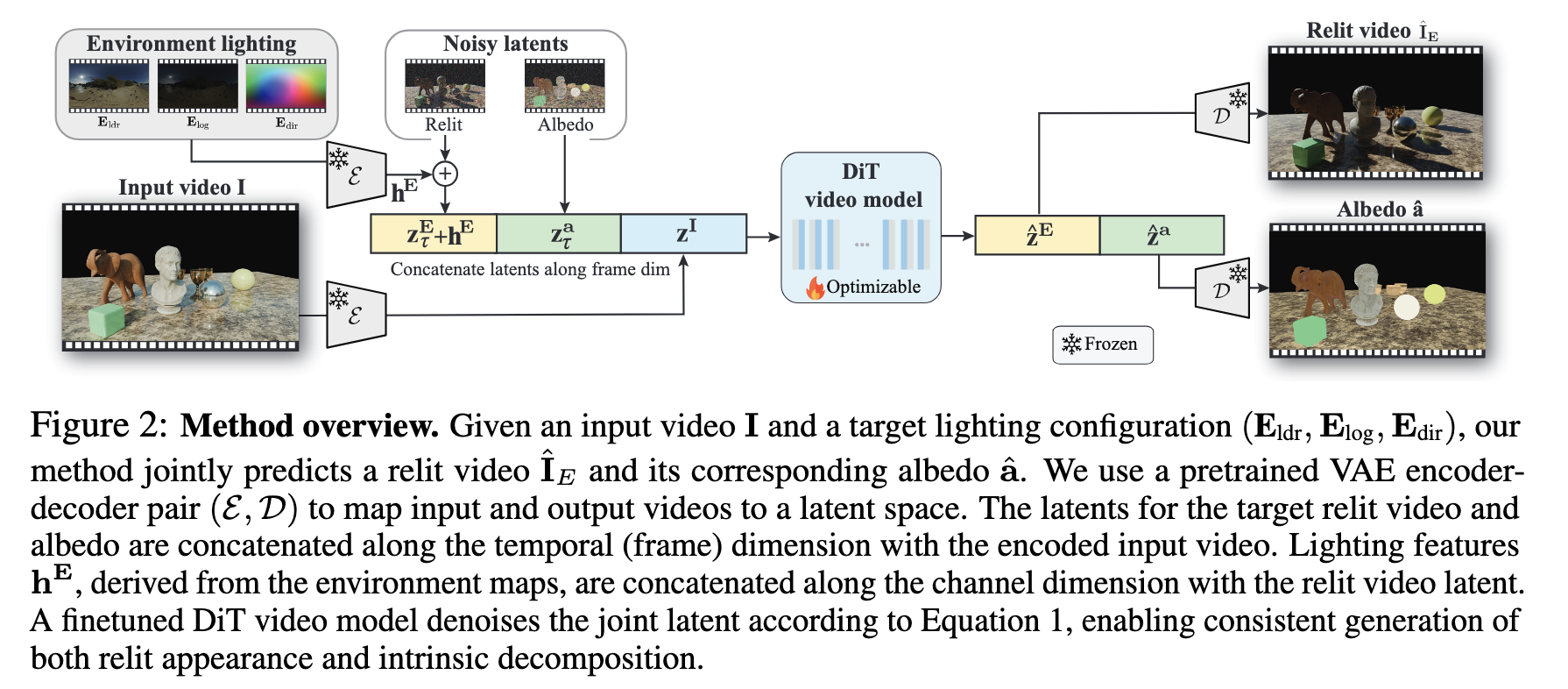
UniRelight formulate the video relighting problem as a joint tasks of both relighting and delighting. Given noise latent of relit video and albedo(delight task) map concatenated to input video, the video diffusion model is trained to generate frames of both relit video and albedo video sequentially, conditioned on the environment lighting.
“This design is motivated by the hypothesis that demodulation provides a strong prior for the relighting task, such as removing shadows. This joint formulation encourages the model to learn an internal representation of scene structure, leading to improved generalization across diverse and unseen domains.”
Similar to this idea, GeoRelight[43] also utilizes joint modeling idea.
This work curates a large volume of high-quality synthetic dataset together with a smaller, low-quality pseudo-labelled real-world data. The synthetic dataset is rendered from 36.5k 3D object assets from Objaverse LVIS subset, and 766 HDRI environment maps.
✅ Paper Title: UniLumos: Fast and Unified Image and Video Relighting with Physics-Plausible Feedback [45] TL;DR: 统一图像和视频 relighting,并通过 physics-plausible feedback 提升速度与一致性。
Authors first claim that “Generic generation scores (e.g., FID, LPIPS) fail to capture lighting-specific errors such as shadow misalignment, intensity mismatch, or incorrect light direction.” Therefore they propose Lumos Score to utilize VLM to score image relighting quality in 6 dimensions: direction of light, lihgt source type, light intensity, color temperature, light changes, optical. Lumos Score utilize VLM to label generated images to compare with structured text prompts or ground truth images as evaluation.
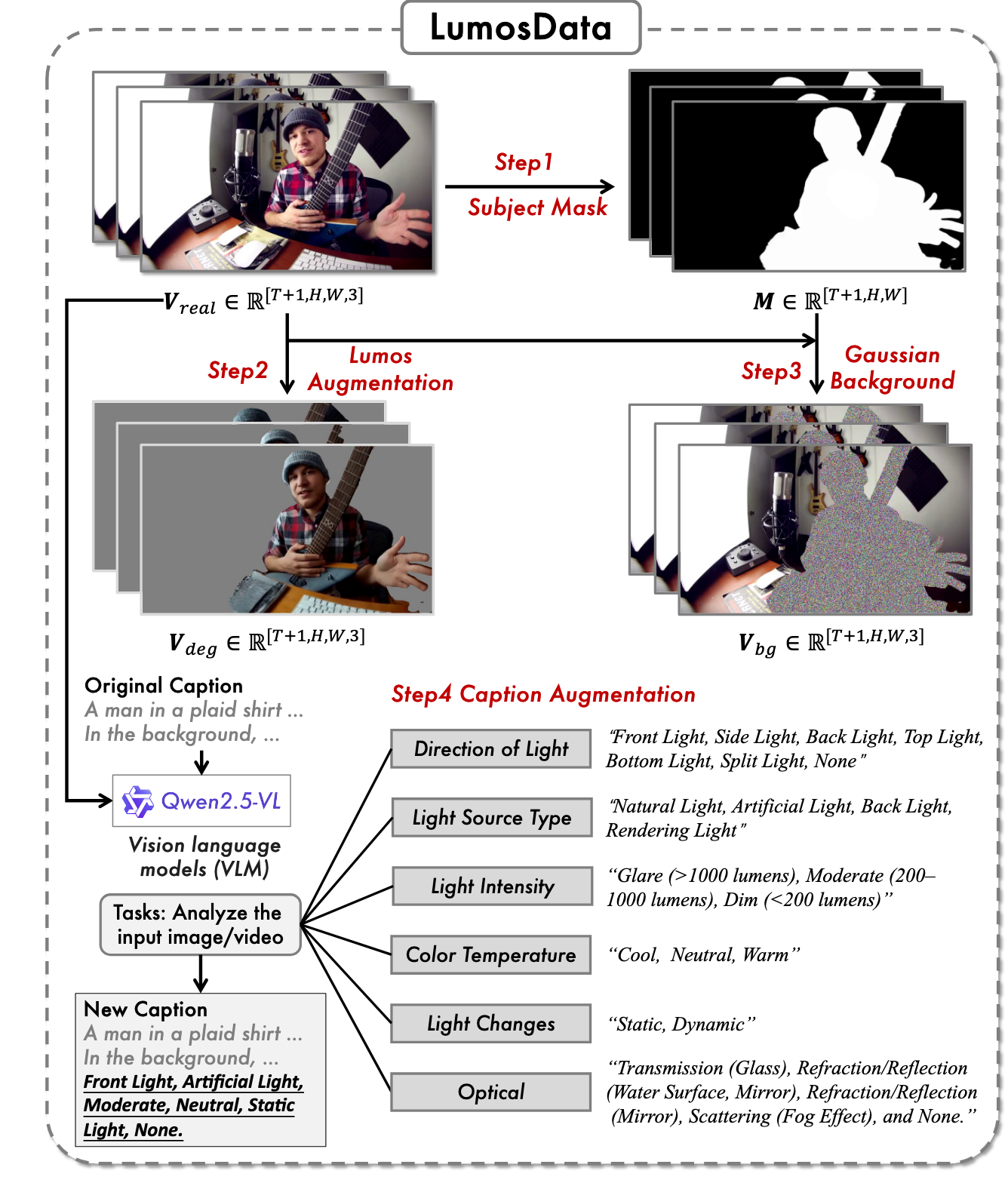
But the problem lies in that these judgements depend on VLM instead of standardized, fully-reproducible metrics. The judging ability of VLMs is sceptical, as they may not physically understand light transport and may generate haluccinated answers. Besides, the boundry of semantic labels are instrinsiscally vague and ill-defined(e.g. what is the boundry of cool and neutral in color temperature?)
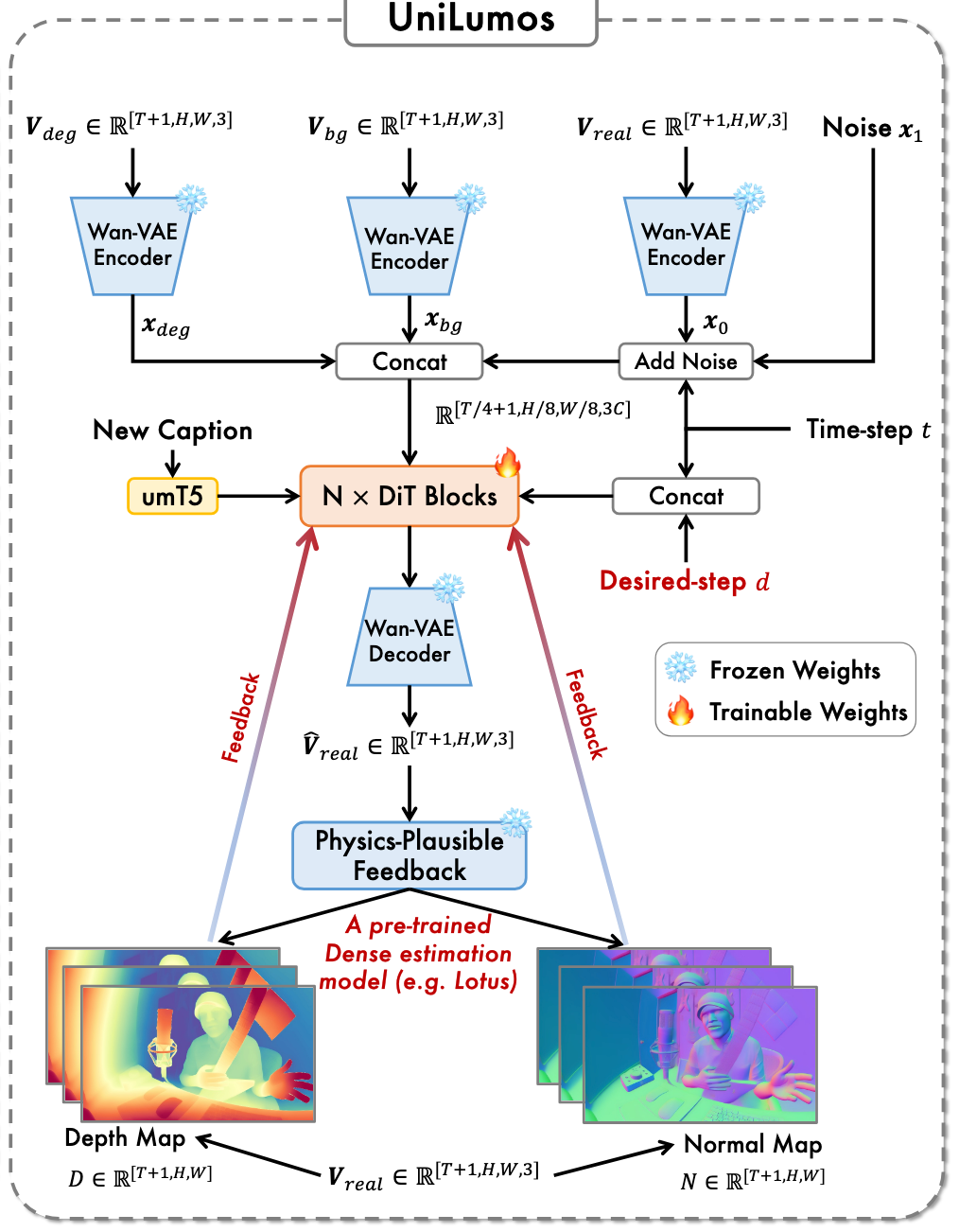
This paper proposes a physical-plausible feedback loss term, which utilizes off-the-shelf depth and normal map estimators to predict depth map and normal map, and then compare them to original image as constraint terms. This typical term of intrinsic consistency loss is quite commonly used in recent works.
✅ Paper Title: LightCtrl: Training-free Controllable Video Relighting [50] TL;DR: 提出 training-free 的可控视频 relighting,适合讨论无需额外训练的 video diffusion 控制策略。
LightCtrl proposes a training-free framework of controllable relighting video generation. It incroporates IC-Light as a frozen frame relighting tool and uses a frozen video diffusion model to generate consistent frames. The essential workflow is to utilize IC-Light to relight each frame of the video during denoising steps.
This work defines a way to represent the lighting condition using masked representations with random noise. It estimates normal map as low-frequency information and mix it with RGB original image as high-frequency information together using FFT & IFFT technique. Then uses this to condition IC-Light for a geometry-aware relighting.
I personally think this paper does not meet the quality of ICLR 2026. Few contributions and hard-to-understand workflow. Question: why is the frozen IC-Light able to understand the fused normal+RGB map as condition?
Volumetric Rendering Models: NeRF, EG3D, 3DGS, and Avatar Representations
-
Paper Title: VoRF: Volumetric Relightable Faces [51] TL;DR: 用 volumetric representation 表达人脸可重光照外观,是 NeRF-style relightable face 的早期代表。
-
Paper Title: Relightable Gaussian Codec Avatars [52]aito2023relightable} TL;DR: 将 Gaussian avatar 表示扩展到可重光照外观,连接 3DGS avatar 与 relighting。
-
Paper Title: RelightAnyone: A Generalized Relightable 3D Gaussian Head Model [37] TL;DR: 构建泛化的 relightable 3D Gaussian head model,面向单人头部 avatar relighting。
-
Paper Title: Relightable Holoported Characters: Capturing and Relighting Dynamic Human Performance from Sparse Views [53] TL;DR: 从稀疏视角捕捉并重光照动态人物表演,适合放在 dynamic volumetric human relighting。
-
Paper Title: 3DPR: Single Image 3D Portrait Relighting with Generative Priors [33] TL;DR: 用生成先验补足单图 3D portrait relighting 的不可观测信息。
Evaluation, Benchmarks, and Failure Analysis
✅🏆 Paper Title: Do Image Editing Models Understand Lighting? [54] TL;DR: 评估现有 image editing models 是否真正理解光照,可作为 relighting 任务评价和 failure mode 分析的切入点。
This work asks a critical question in relighting task: even though current image editing models can generate plausible relit image like “turn-on/turn-off” lights, do they really understand light transport? or they might just generate errorneous images which fit eval metrics(LPIPS, SSIM, PSNR)?
The authors further claims as “While prior works [29, 42, 26, 19, 56] use PSNR, SSIM [50], and LPIPS [58] to assess relighting accuracy, these metrics suffer from several weaknesses for our purpose.”
In this work, they curated a 1k real on-and-off image pairs and performs turn-on-the-light / turn-of-the-light task to image editing models and relighting models. To rigorously evaluate results, they point out the problem of other affecting factors(white balance, exposure) which GT image and generated image may automatically change to avoid over- or under- exposed images, which would influence the traditional evaluating metrics as they are sensitive to these factors.
Therefore, they proposed two radiometric evaluation metrics which are insensitive to aforementioned factors(could be simply regarded as taking division of on vs. off image on pixel space and taking derivatives of the former one to calculate light transport in pixel space).
Experiments shows that: 1) conventional metrics(PSNR, SSIM, LPIPS) are not suitable as radiometric scores to relighting task. 2) VLMs can even tell which image is either GT or generated.
✅ Paper Title: WildRelight: A Real-World Benchmark and Physics-Guided Adaptation for Single-Image Relighting [39] TL;DR: 提供真实世界 benchmark,适合在实验设置和 real-world generalization 小节重点引用。
This work provides a small but rich outdoor real captured (image, HDR) paired dataset as benchmark, which mitigate the long-standing problem that real caputured relit images in complex scenes(unlike light stage dataset which is simple light settings) donnot have GT lighting conditions but could only predict lighting conditions as pseudo GTs.
✅ Paper Title: SpatialReward: Verifiable Spatial Reward Modeling for Fine-Grained Spatial Consistency in Text-to-Image Generation [11] TL;DR: 虽不是 relighting benchmark,但其 verifiable reward 思路可迁移到光源方向、阴影位置和空间一致性评价。
see annotations elsewhere.
References
- Ho, Jonathan, Jain, Ajay, Abbeel, Pieter (2020). Denoising Diffusion Probabilistic Models. Advances in Neural Information Processing Systems. https://arxiv.org/abs/2006.11239.
- Song, Jiaming, Meng, Chenlin, Ermon, Stefano (2021). Denoising Diffusion Implicit Models. International Conference on Learning Representations. https://arxiv.org/abs/2010.02502.
- Rombach, Robin, Blattmann, Andreas, Lorenz, Dominik, Esser, Patrick, Ommer, Bjorn (2022). High-Resolution Image Synthesis with Latent Diffusion Models. Proceedings of the IEEE/CVF Conference on Computer Vision and Pattern Recognition. https://arxiv.org/abs/2112.10752.
- Peebles, William, Xie, Saining (2023). Scalable Diffusion Models with Transformers. Proceedings of the IEEE/CVF International Conference on Computer Vision. https://arxiv.org/abs/2212.09748.
- Zhao, Bing, Wu, Chenfei, Li, Deqing, Meng, Hao, Li, Jiahao, Zhang, Jie, Zhou, Jingren, Lin, Junyang, Gao, Kaiyuan, Cao, Kuan, Yan, Kun, Peng, Liang, Jiang, Lihan, Li, Niantong, Tang, Ningyuan, Yin, Shengming, Wu, Tianhe, Xu, Xiao, Chen, Xiaoyue, Wang, Xihua, Shu, Yan, Zhang, Yanran, Wang, Yi, Chen, Yilei, Ba, Ying, Xu, Yixian, Wu, Yujia, Chen, Yuxiang, Tang, Zecheng, Zhang, Zekai, Wang, Zhendong, Liu, Zihao, Zhou, Zikai, Yang, An, Cheng, Chen, Lv, Chenxu, Liu, Dayiheng, Zhou, Fan, Xiong, Hantian, Shi, Hongzhu, Wei, Hu, Zhao, Huihong, Liu, Ivy, Zhang, Jianwei, Zhang, Jiawei, Chen, Kai, He, Kang, Xue, Levon, Qu, Lin, Tang, Linhan, Feng, Luwen, Wu, Minggang, Sun, Minmin, Ni, Na, Men, Rui, Bai, Shuai, Zheng, Sishou, Lan, Tao, Zhang, Tianqi, Wen, Tingkun, Wang, Wei, Qiao, Weixu, Lu, Weiyi, Zhou, Wenmeng, Deng, Xiaodong, Xu, Xiaoxiao, Fang, Xinlei, Chen, Xionghui, Wang, Yanan, Fan, Yang, Zhang, Yichang, Xu, Yixuan, Wu, Yu, Ma, Zhiyuan, Cai, Zhizhi (2026). Qwen-Image-2.0 Technical Report. https://arxiv.org/abs/2605.10730.
- Lipman, Yaron, Chen, Ricky T. Q., Ben-Hamu, Heli, Nickel, Maximilian, Le, Matthew (2023). Flow Matching for Generative Modeling. International Conference on Learning Representations. https://arxiv.org/abs/2210.02747.
- Holderrieth, Peter, Erives, Ezra (2025). An Introduction to Flow Matching and Diffusion Models. https://arxiv.org/abs/2506.02070.
- Preechakul, Konpat, Chatthee, Nattanat, Wizadwongsa, Suttisak, Suwajanakorn, Supasorn (2022). Diffusion Autoencoders: Toward a Meaningful and Decodable Representation. Proceedings of the IEEE/CVF Conference on Computer Vision and Pattern Recognition. https://arxiv.org/abs/2111.15640.
- Liu, Jie, Liu, Gongye, Liang, Jiajun, Li, Yangguang, Liu, Jiaheng, Wang, Xintao, Wan, Pengfei, Zhang, Di, Ouyang, Wanli (2025). Flow-GRPO: Training Flow Matching Models via Online RL. https://arxiv.org/abs/2505.05470.
- Xu, Jiazheng, Liu, Xiao, Wu, Yuchen, Tong, Yuxuan, Li, Qinkai, Ding, Ming, Tang, Jie, Dong, Yuxiao (2023). ImageReward: Learning and Evaluating Human Preferences for Text-to-Image Generation. Advances in Neural Information Processing Systems. https://arxiv.org/abs/2304.05977.
- Zhou, Sashuai, Zhou, Qiang, Ma, Junpeng, Cao, Yue, Hu, Ruofan, Zhang, Ziang, Yang, Xiaoda, Wang, Zhibin, Song, Jun, Yu, Cheng, Zheng, Bo, Zhao, Zhou (2026). SpatialReward: Verifiable Spatial Reward Modeling for Fine-Grained Spatial Consistency in Text-to-Image Generation. Proceedings of the IEEE/CVF Conference on Computer Vision and Pattern Recognition. https://arxiv.org/abs/2603.22228.
- Zhao, Xiangyu, Zhang, Peiyuan, Lin, Junming, Liang, Tianhao, Duan, Yuchen, Ding, Shengyuan, Tian, Changyao, Zang, Yuhang, Yan, Junchi, Yang, Xue (2026). Trust Your Critic: Robust Reward Modeling and Reinforcement Learning for Faithful Image Editing and Generation. https://arxiv.org/abs/2603.12247.
- Guo, Hanzhong, Wu, Jie, Liu, Jie, Gao, Yu, Ye, Zilyu, Yuan, Linxiao, Wang, Xionghui, Yu, Yizhou, Huang, Weilin (2026). Leveraging Verifier-Based Reinforcement Learning in Image Editing. Proceedings of the IEEE/CVF Conference on Computer Vision and Pattern Recognition. https://arxiv.org/abs/2604.27505.
- Luo, Xin, Wang, Jiahao, Wu, Chenyuan, Xiao, Shitao, Jiang, Xiyan, Lian, Defu, Zhang, Jiajun, Liu, Dong, Liu, Zheng (2026). EditScore: Unlocking Online RL for Image Editing via High-Fidelity Reward Modeling. International Conference on Learning Representations. https://arxiv.org/abs/2509.23909.
- Brown, Will, Opus, Claude (2026). SFT, RL, and On-Policy Distillation Through a Distributional Lens. https://nrehiew.github.io/blog/sft_rl_opd/.
- Jiang, Yuming, Zhao, Nanxuan, Liu, Qing, Singh, Krishna Kumar, Yang, Shuai, Loy, Chen Change, Liu, Ziwei (2024). GroupDiff: Diffusion-based Group Portrait Editing. European Conference on Computer Vision. https://arxiv.org/abs/2409.14379.
- Zhang, Yifan, Wang, Jianguo, Tang, Zhongliang, Wang, Wenmin (2026). Insert Anyone: High-fidelity Full-body Photo Insertion via Dual-branch Adapters. Expert Systems with Applications. doi:10.1016/j.eswa.2025.131013.
- Fei, Zhengcong, Li, Debang, Qiu, Di, Yu, Changqian, Fan, Mingyuan (2025). Ingredients: Blending Custom Photos with Video Diffusion Transformers. https://arxiv.org/abs/2501.01790.
- Zeng, Ying, Luo, Miaosen, Li, Guangyuan, Yang, Yang, Fan, Ruiyang, Shi, Linxiao, Yang, Qirui, Zhang, Jian, Liu, Chengcheng, Zheng, Siming, Chen, Jinwei, Li, Bo, Jiang, Peng-Tao (2026). SmartPhotoCrafter: Unified Reasoning, Generation and Optimization for Automatic Photographic Image Editing. https://arxiv.org/abs/2604.19587.
- She, Dong, Fu, Siming, Liu, Mushui, Jin, Qiaoqiao, Wang, Hualiang, Liu, Mu, Jiang, Jidong (2026). MOSAIC: Multi-Subject Personalized Generation via Correspondence-Aware Alignment and Disentanglement. International Conference on Learning Representations. https://arxiv.org/abs/2509.01977.
- Zhang, Yimeng, Zhi, Tiancheng, Liu, Jing, Sang, Shen, Jiang, Liming, Yan, Qing, Liu, Sijia, Luo, Linjie (2025). ID-Patch: Robust ID Association for Group Photo Personalization. Proceedings of the IEEE/CVF Conference on Computer Vision and Pattern Recognition. https://arxiv.org/abs/2411.13632.
- Purkrabek, Miroslav, Matas, Jiri (2025). Detection, Pose Estimation and Segmentation for Multiple Bodies: Closing the Virtuous Circle. Proceedings of the IEEE/CVF International Conference on Computer Vision. https://arxiv.org/abs/2412.01562.
- Purkrabek, Miroslav, Kolomiiets, Constantin, Matas, Jiri (2026). BBoxMaskPose v2: Expanding Mutual Conditioning to 3D. https://arxiv.org/abs/2601.15200.
- Yin, Shengming, Zhang, Zekai, Tang, Zecheng, Gao, Kaiyuan, Xu, Xiao, Yan, Kun, Li, Jiahao, Chen, Yilei, Chen, Yuxiang, Shum, Heung-Yeung, Ni, Lionel M., Zhou, Jingren, Lin, Junyang, Wu, Chenfei (2026). Qwen-Image-Layered: Towards Inherent Editability via Layer Decomposition. Proceedings of the IEEE/CVF Conference on Computer Vision and Pattern Recognition. https://arxiv.org/abs/2512.15603.
- Rowles, Ciara, Adithyan, Reshinth, Pinnaparaju, Nikhil, Voleti, Vikram, Boss, Mark (2026). Stable-Layers: Fine-Tuning Image Layer Decomposition Models with VLM-Scored Reinforcement Learning. https://arxiv.org/abs/2605.30257.
- Chen, Ruidong, Bai, Yancheng, Zhang, Xuanpu, Zeng, Jianhao, Wang, Lanjun, Song, Dan, Sun, Lei, Chu, Xiangxiang, Liu, Anan (2026). LayerBind: Layer-wise Instance Binding for Regional and Occlusion Control in Text-to-Image Diffusion Transformers. Proceedings of the IEEE/CVF Conference on Computer Vision and Pattern Recognition. https://arxiv.org/abs/2603.05769.
- Yang, Zhitao, Cai, Zhongang, Mei, Haiyi, Liu, Shuai, Chen, Zhaoxi, Xiao, Weiye, Wei, Yukun, Qing, Zhongfei, Wei, Chen, Dai, Bo, Wu, Wayne, Qian, Chen, Lin, Dahua, Liu, Ziwei, Yang, Lei (2023). SynBody: Synthetic Dataset with Layered Human Models for 3D Human Perception and Modeling. Proceedings of the IEEE/CVF International Conference on Computer Vision. https://arxiv.org/abs/2303.17368.
- Black, Michael J., Patel, Priyanka, Tesch, Joachim, Yang, Jinlong (2023). BEDLAM: A Synthetic Dataset of Bodies Exhibiting Detailed Lifelike Animated Motion. Proceedings of the IEEE/CVF Conference on Computer Vision and Pattern Recognition. doi:10.1109/CVPR52729.2023.00843.
- Tesch, Joachim, Becherini, Giorgio, Achar, Prerana, Yiannakidis, Anastasios, Kocabas, Muhammed, Patel, Priyanka, Black, Michael J. (2025). BEDLAM2.0: Synthetic Humans and Cameras in Motion. Advances in Neural Information Processing Systems, Datasets and Benchmarks Track. https://arxiv.org/abs/2511.14394.
- Debevec, Paul, Hawkins, Tim, Tchou, Chris, Duiker, Haarm-Pieter, Sarokin, Westley, Sagar, Mark (2000). Acquiring the Reflectance Field of a Human Face. Proceedings of the 27th Annual Conference on Computer Graphics and Interactive Techniques. doi:10.1145/344779.344855.
- Zhang, Lvmin, Rao, Anyi, Agrawala, Maneesh (2025). Scaling In-the-Wild Training for Diffusion-based Illumination Harmonization and Editing by Imposing Consistent Light Transport. International Conference on Learning Representations. https://openreview.net/forum?id=u1cQYxRI1H.
- Magar, Nadav, Hertz, Amir, Tabellion, Eric, Pritch, Yael, Rav-Acha, Alex, Shamir, Ariel, Hoshen, Yedid (2025). LightLab: Controlling Light Sources in Images with Diffusion Models. ACM SIGGRAPH Conference Papers. doi:10.1145/3721238.3730696.
- Rao, Pramod, Meka, Abhimitra, Zhou, Xilong, Fox, Gereon, B R, Mallikarjun, Zhan, Fangneng, Weyrich, Tim, Bickel, Bernd, Pfister, Hanspeter, Matusik, Wojciech, Beeler, Thabo, Elgharib, Mohamed, Habermann, Marc, Theobalt, Christian (2025). 3DPR: Single Image 3D Portrait Relighting with Generative Priors. ACM SIGGRAPH Asia Conference Proceedings. https://arxiv.org/abs/2510.15846.
- Chen, Zhuo, Yang, Chengqun, Su, Zhuo, Lv, Zheng, Gao, Jingnan, Zhang, Xiaoyuan, Yang, Xiaokang, Yan, Yichao (2026). POLAR: A Portrait OLAT Dataset and Generative Framework for Illumination-Aware Face Modeling. Proceedings of the IEEE/CVF Conference on Computer Vision and Pattern Recognition. https://arxiv.org/abs/2512.13192.
- Chaturvedi, Sumit, Ren, Mengwei, Hold-Geoffroy, Yannick, Liu, Jingyuan, Dorsey, Julie, Shu, Zhixin (2025). SynthLight: Portrait Relighting with Diffusion Model by Learning to Re-render Synthetic Faces. Proceedings of the IEEE/CVF Conference on Computer Vision and Pattern Recognition. https://arxiv.org/abs/2501.09756.
- Han, Yuxuan, Ming, Xin, Li, Tianxiao, Shen, Zhuofan, Zhang, Qixuan, Xu, Lan, Xu, Feng (2026). Learning a Delighting Prior for Facial Appearance Capture in the Wild. ACM SIGGRAPH Conference Proceedings. https://arxiv.org/abs/2605.05636.
- Xu, Yingyan, Rao, Pramod, Weiss, Sebastian, Zoss, Gaspard, Gross, Markus, Theobalt, Christian, Habermann, Marc, Bradley, Derek (2026). RelightAnyone: A Generalized Relightable 3D Gaussian Head Model. https://arxiv.org/abs/2601.03357.
- Huang, Qian, Jaiswal, Mayoore Selvarasa, Zhong, Zhen, Pereira, Rochelle, Min, Jianyuan (2026). Toward Real-World Adoption of Portrait Relighting via Hybrid Domain Knowledge Fusion. https://arxiv.org/abs/2604.23094.
- Wang, Lezhong, Kaya, Mehmet Onurcan, Bigdeli, Siavash, Frisvad, Jeppe Revall (2026). WildRelight: A Real-World Benchmark and Physics-Guided Adaptation for Single-Image Relighting. https://arxiv.org/abs/2605.11696.
- Zhang, Zitian, Georgiev, Iliyan, Fischer, Michael, Hold-Geoffroy, Yannick, Lalonde, Jean-Francois, Deschaintre, Valentin (2026). UniLight: A Unified Representation for Lighting. Proceedings of the IEEE/CVF Conference on Computer Vision and Pattern Recognition. https://arxiv.org/abs/2512.04267.
- Zhou, Gengze, Wang, Tianyu, Kim, Soo Ye, Shu, Zhixin, Yu, Xin, Hold-Geoffroy, Yannick, Chaturvedi, Sumit, Wu, Qi, Lin, Zhe, Cohen, Scott (2026). LightMover: Generative Light Movement with Color and Intensity Controls. Proceedings of the IEEE/CVF Conference on Computer Vision and Pattern Recognition. https://arxiv.org/abs/2603.27209.
- He, Kai, Liang, Ruofan, Munkberg, Jacob, Hasselgren, Jon, Vijaykumar, Nandita, Keller, Alexander, Fidler, Sanja, Gilitschenski, Igor, Gojcic, Zan, Wang, Zian (2025). UniRelight: Learning Joint Decomposition and Synthesis for Video Relighting. Advances in Neural Information Processing Systems. https://arxiv.org/abs/2506.15673.
- Xue, Yuxuan, Liang, Ruofan, Zakharov, Egor, Bagautdinov, Timur, Cao, Chen, Nam, Giljoo, Saito, Shunsuke, Pons-Moll, Gerard, Romero, Javier (2026). GeoRelight: Learning Joint Geometrical Relighting and Reconstruction with Flexible Multi-Modal Diffusion Transformers. Proceedings of the IEEE/CVF Conference on Computer Vision and Pattern Recognition. https://arxiv.org/abs/2604.20715.
- Liang, Zhexin, Chen, Zhaoxi, Chen, Yongwei, Wei, Tianyi, Wang, Tengfei, Pan, Xingang (2026). PI-Light: Physics-Inspired Diffusion for Full-Image Relighting. International Conference on Learning Representations. https://arxiv.org/abs/2601.22135.
- Liu, Ropeway, Yuan, Hangjie, Dong, Bo, Xing, Jiazheng, Wang, Jinwang, Zhao, Rui, Xing, Yan, Chen, Weihua, Wang, Fan (2025). UniLumos: Fast and Unified Image and Video Relighting with Physics-Plausible Feedback. Advances in Neural Information Processing Systems. https://arxiv.org/abs/2511.01678.
- Song, Yukai, Xu, Guangxin, Zhang, Xiaoyan, Zhang, Zhijun (2024). BiPR-RL: Portrait Relighting via Bi-directional Consistent Deep Reinforcement Learning. Computer Vision and Image Understanding.
- Ponglertnapakorn, Puntawat, Tritrong, Nontawat, Suwajanakorn, Supasorn (2023). DiFaReli: Diffusion Face Relighting. Proceedings of the IEEE/CVF International Conference on Computer Vision. doi:10.1109/ICCV51070.2023.02070.
- Ponglertnapakorn, Puntawat, Tritrong, Nontawat, Suwajanakorn, Supasorn (2026). DiFaReli++: Diffusion Face Relighting with Consistent Cast Shadows. IEEE Transactions on Pattern Analysis and Machine Intelligence. https://arxiv.org/abs/2304.09479.
- Bharadwaj, Shrisha, Feng, Haiwen, Becherini, Giorgio, Fernandez Abrevaya, Victoria, Black, Michael J. (2025). GenLit: Reformulating Single-Image Relighting as Video Generation. ACM SIGGRAPH Asia Conference Proceedings. doi:10.1145/3757377.3763970.
- Peng, Yizuo, Chen, Xuelin, Zhang, Kai, Cun, Xiaodong (2026). LightCtrl: Training-free Controllable Video Relighting. International Conference on Learning Representations. https://arxiv.org/abs/2603.27083.
- Rao, Pramod, B R, Mallikarjun, Fox, Gereon, Weyrich, Tim, Bickel, Bernd, Seidel, Hans-Peter, Pfister, Hanspeter, Matusik, Wojciech, Tewari, Ayush, Theobalt, Christian, Elgharib, Mohamed (2022). VoRF: Volumetric Relightable Faces. British Machine Vision Conference. https://vcg.seas.harvard.edu/publications/20221206-vorf.
- Saito, Shunsuke, Schwartz, Gabriel, Simon, Tomas, Li, Junxuan, Nam, Giljoo (2023). Relightable Gaussian Codec Avatars. https://arxiv.org/abs/2312.03704.
- Singh, Kunwar Maheep, Chen, Jianchun, Golyanik, Vladislav, Garbin, Stephan J., Beeler, Thabo, Dabral, Rishabh, Habermann, Marc, Theobalt, Christian (2026). Relightable Holoported Characters: Capturing and Relighting Dynamic Human Performance from Sparse Views. Proceedings of the IEEE/CVF Conference on Computer Vision and Pattern Recognition. https://arxiv.org/abs/2512.00255.
- K\"uchler, Tim, Feiden, Johann-Friedrich, Nie\ssner, Matthias, Rother, Carsten (2026). Do Image Editing Models Understand Lighting?. https://arxiv.org/abs/2606.26738.
- Xu, Hengyuan, Cheng, Wei, Xing, Peng, Fang, Yixiao, Wu, Shuhan, Wang, Rui, Zeng, Xianfang, Jiang, Daxin, Yu, Gang, Ma, Xingjun, Jiang, Yu-Gang (2026). WithAnyone: Towards Controllable and ID Consistent Image Generation. International Conference on Learning Representations. https://arxiv.org/abs/2510.14975.
- Jiang, Liming, Yan, Qing, Jia, Yumin, Liu, Zichuan, Kang, Hao, Lu, Xin (2025). InfiniteYou: Flexible Photo Recrafting While Preserving Your Identity. Proceedings of the IEEE/CVF International Conference on Computer Vision. https://arxiv.org/abs/2503.16418.